
Gigpie vs Mindbody: Wellness-Industry Software or Education Fit?
An honest Gigpie vs Mindbody comparison: what Mindbody's Appointments type and Family Accounts actually do, verified August 2026 pricing, and which platform fits an education business.
Mindbody is the appointment and class-booking platform behind tens of thousands of fitness studios, spas, and salons, with a native Appointments type built for one-provider-one-client bookings, a named Family Accounts feature, and pricing that starts at $79 a month per location before scaling into sales-quoted tiers, as of August 2026. Gigpie is built for the education side of that same booking-and-billing problem: packages sold in hours instead of visits, a family record that pools those hours across every sibling, and a progress note attached to every session, for a flat 2% of what you collect and nothing due before you collect it. An earlier version of this page claimed Mindbody was class-only with no family structures; both claims were wrong, and this rewrite corrects them before making the real case for each platform.
Quick Comparison
| Feature | Gigpie | Mindbody |
|---|---|---|
| Pricing model | Flat 2% of collections | Per-location subscription, from $79/mo |
| Cost before you have revenue | Free until you collect revenue | No published trial; sales call required |
| Published card processing rate | Stripe, 2.9% + $0.30 | Not published |
| Published ACH / pay-by-bank rate | Stripe, 0.8%, capped at $5 | Not documented |
| Unlimited staff, no seat fees | Yes | Yes |
| Native 1-on-1 appointment type (separate from Classes) | Yes | Yes |
| Family account: book and pay for the household on one login | Yes | Partial |
| Independent login for each student or dependent | Yes | No |
| One purchase's hours pooled across siblings | Yes | Not documented |
| Note/content record per session | Yes | No |
| Payroll | Pay runs with approval, CSV export | Earnings report, exports to ADP/Paychex/Exact |
| Calendar sync | Push + conflict check, Google & Outlook | One-way: staff schedule to personal calendar |
| CRM with pipelines, campaigns, and journeys | Yes | Not documented |
| AI agent for inbound phone calls | Yes | Not documented |
| Post-session review/reputation funnel | Yes | Not documented |
| Dedicated staff mobile app | No | Yes |
| Live chat and phone support | No | Yes |
Every Mindbody detail above comes from mindbodyonline.com's pricing, payments, scheduling, client-experience, and business-app pages, plus its own support and Learning Center articles, checked in August 2026. "Not documented" means Mindbody's public materials don't confirm the detail either way; it isn't a claim the feature is missing.
Pricing: What Mindbody Publishes (and What It Doesn't)
Gigpie
Gigpie's only pricing number is the platform fee: a flat 2% of what you collect, with nothing due before you collect it and no tiers to choose between. Stripe's processing runs separately, the same as it would on any platform: 2.9% + $0.30 per card transaction, 0.8% capped at $5 for pay-by-bank.
Mindbody
Mindbody's own pricing page names three tiers, Starter, Accelerate, and Ultimate, plus a custom Enterprise plan, as of August 2026. Only Starter has a public number: starting at $79 a month per location, with unlimited staff included. Accelerate and Ultimate show no dollar figure at all, just a button that routes to a sales call, and the page never says what separates one tier's feature set from the next. We'd previously listed Starter at roughly $159, Accelerate at $319, Ultimate at $559, a fourth "Ultimate Plus" tier, and a 2.6% + $0.30 transaction fee. None of that survives a check against the current site: the real Starter floor is lower, the higher tiers are quote-gated rather than priced, there's no Ultimate Plus, and Mindbody's payments page publishes no percentage at all.
What the one verified number buys you. $79/month is flat regardless of revenue, so the crossover against Gigpie's 2% sits at about $3,950/month collected: below that, Gigpie's fee costs less than even Mindbody's cheapest published tier; above it, Starter looks cheaper on paper. But Starter's real fit for a multi-coach education business isn't published, and most businesses running packages, family billing, and more than a couple of staff may land in Accelerate or Ultimate, whose prices Mindbody won't disclose without a sales call. We can tell you Gigpie costs $60/month at $3,000 collected, $300 at $15,000, and $800 at $40,000. We can't tell you what Mindbody costs at $15,000 or $40,000, and neither can you, until you get a quote.
That opacity cuts both ways. A large single-location studio doing high class volume might negotiate a good Ultimate rate; a small education business asking about Accelerate might not. Gigpie's price is the only one either of us can verify past the first tier, and Mindbody's per-location structure adds a second variable Gigpie doesn't have at all.
What Mindbody Does Well
This page used to claim Mindbody was class-only with no support for individual sessions. That was wrong, and it deserves a straight fix: Mindbody has a distinct, natively marketed Appointments type, separate from Classes, built for exactly the one-provider-one-client shape a tutoring session takes, plus dedicated pages for personal trainers and other 1-on-1 services, confirmed directly on mindbodyonline.com as of August 2026. Its client-experience page also describes automatic visit, balance, and expiration tracking for both memberships and class packs, visible to the client, not the manual workaround this page used to describe. Family Accounts is a real, named feature too: one login books, buys, and manages the whole household, and each dependent gets a visit-history profile on the business's own schedule.
Mindbody's staff side is more complete than a class scheduler needs to be, as well. The Business app, included free with every plan, gives owners and staff client, schedule, and point-of-sale access from a phone. The Payroll report tracks hourly pay, tips, and commissions in one place and exports to ADP, Paychex, or Exact Payroll for a full run, broader than "commission on class attendance" describes. Its contact page runs live chat, and a phone number turns up on Mindbody's own BBB listing, both real gaps in what Gigpie offers today: Gigpie is email and a contact form.
Where Gigpie Goes Further
Where the two products still diverge is scope and shape, not existence. Mindbody's Family Accounts feature is opt-in per business and gives one household one shared login; dependents don't get their own login credentials, and whether a class pack's remaining visits pool across the dependents on that account isn't documented anywhere on Mindbody's site. In Gigpie, a purchase belongs to the family: buy a 20-hour package for two kids in two subjects with two different coaches, and both draw from the same balance automatically without any setup, while each student can also get a login of their own if the family wants it.
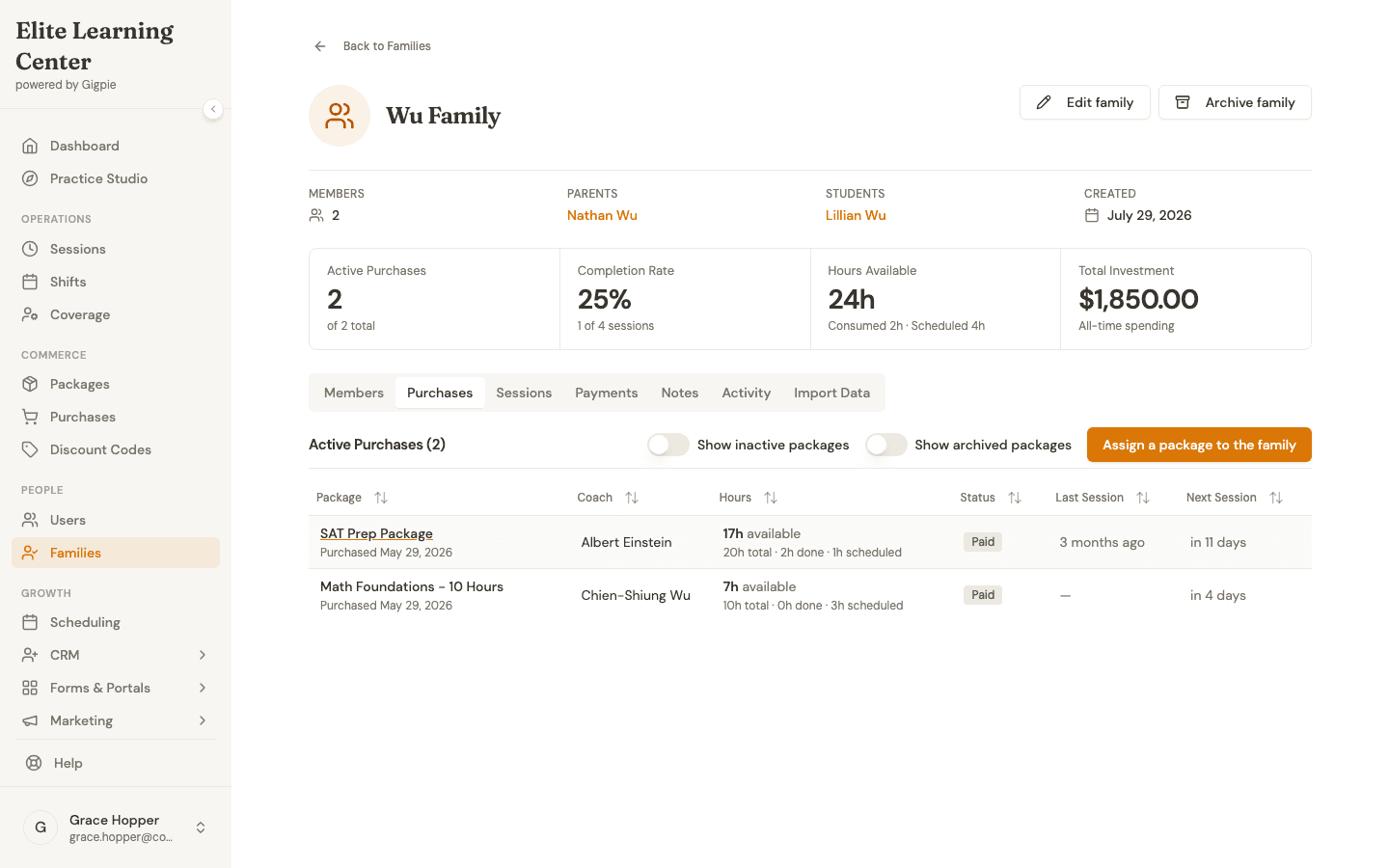 One purchase, split however the family's sessions land: the same shape a tutoring or coaching business actually sells.
The other real gap is educational content. Mindbody's client-experience page describes attendance, visit counts, and balances; nothing on its site describes what happened during the visit. Every completed Gigpie session carries a note the family can read the moment it ends, alongside homework tasks and a session-by-session history a parent can search months later.
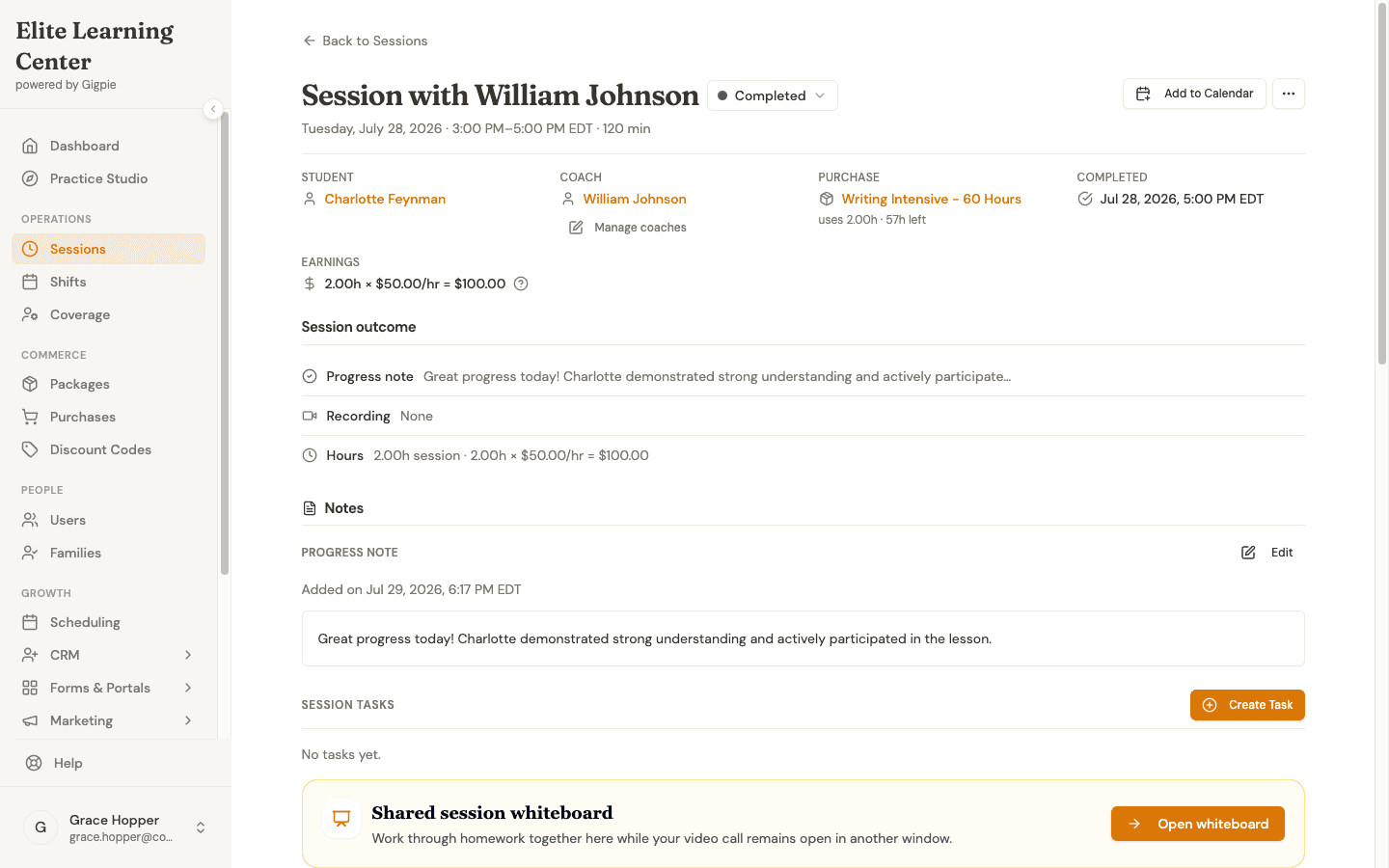 A record a fitness booking platform has no reason to build, and a tutoring business can't operate without.
Gigpie also runs a CRM with lead pipelines and journey automations, an AI agent that can pick up a call a coach misses mid-session, and a post-session review funnel that routes 4- and 5-star feedback toward Google and Trustpilot. Mindbody's own pages don't document any of this as of August 2026, likely because a fitness studio's marketing problems look different from a tutoring company's.
Verdict by Use Case
A yoga studio, gym, or spa running classes and appointments
Mindbody, without much debate. It's built for this exact business, its Appointments and Classes types cover both service shapes natively, and its Business app and live chat cover ground Gigpie doesn't. Nothing about package-hours billing or session progress notes adds value to a fitness class roster.
A hybrid studio: classes plus some 1-on-1 coaching or private lessons on the side
Depends on which side is the real business. If classes are the core revenue and private sessions are occasional, Mindbody's native support for both types under one login beats running two systems. If ongoing 1-on-1 instruction is actually the larger or growing half, family billing and progress notes start to matter more than class-capacity management.
A tutoring center, test-prep company, or coaching business with no group-class component
Gigpie. Package-as-hours billing, a family record that pools sibling hours, and a note per session all map directly onto what the business sells. Mindbody's Classes and membership-billing architecture would be adapted rather than used as designed, and its published pricing starts well above what a small education business needs to pay for features it won't use.
Migrating From Mindbody
Mindbody's own blog confirms self-serve data export: client lists, appointment history, and sales and staff reports come out as CSV through its Reports section, and a higher-touch paid export service exists for larger or more complex needs. Its cancellation-best-practices article gives you a 30-day window after your subscription ends to pull that data before it becomes inaccessible, so export before you cancel, not after.
Gigpie has no Mindbody-specific importer today, and no general import tool for any outside platform yet; a Mindbody move means re-entering your families, active packages with remaining balances, and coach schedules by hand. Session and appointment history stays in the CSV files you pulled from Mindbody rather than importing directly.
How long that takes scales with your roster: a five-family studio might finish re-entry in an evening, a fifty-family center needs real staff hours. Keep Mindbody active in parallel until every family is actually booking through Gigpie.
Frequently Asked Questions
Can Mindbody actually handle 1-on-1 tutoring sessions?
Yes, more directly than earlier versions of this page suggested. Mindbody's native Appointments type is separate from its Classes type and is built for one-provider-one-client services like personal training and salon visits, the same shape as a tutoring session. Its scheduling page markets classes, appointments, or a mix of both from one screen, as of August 2026.
Does Mindbody have family or household accounts?
Yes. Family Accounts lets one login book, buy, and manage an entire household, and each dependent gets a visit-history profile on the business's own schedule. Two real limits: it's opt-in per business rather than automatic, and dependents don't get their own login credentials, so the parent's single login runs the whole account.
Can a Mindbody family share one package's hours across siblings?
Not documented. Mindbody confirms dependents get individual visit-history profiles, but nothing on its site confirms whether one class pack's remaining visits pool across the dependents on a Family Account. In Gigpie, every package belongs to the family by default, and any student in it draws from the same balance automatically.
Is Gigpie cheaper than Mindbody?
Below about $3,950/month in collections, yes: Gigpie's 2% costs less than even Mindbody's $79/month Starter floor. Above that line, we can't give you a real answer, because Accelerate and Ultimate, the tiers most multi-coach businesses would actually need, are quote-gated with no published price.
Does Mindbody track package or class-pack balances automatically?
Yes. Mindbody's client-experience page confirms automatic tracking of visits, balances, and expiration dates for memberships and class packs, visible to the client. We previously called that tracking manual or limited, which was wrong.
Does Gigpie support group classes, or only 1-on-1 sessions?
Both. Enrollment types cover open, invitation-only, and package-only classes with capacity limits and drop-in pricing, alongside standard 1-on-1 booking. Gigpie isn't class-only in either direction, the same correction this page is making about Mindbody.
How do I migrate from Mindbody to Gigpie?
Manually. Export client lists, appointment history, and sales and staff reports as CSV through Mindbody's Reports section (you get 30 days after cancellation to do this), then re-enter active families, remaining package balances, and staff schedules in Gigpie by hand. There's no direct importer for Mindbody data today.
Does either platform have a native mobile app?
Mindbody does, and it's a real advantage: the Business app, included free with every plan, gives staff client, schedule, and point-of-sale access from a phone. Gigpie has no native app; the parent and coach portals are mobile-responsive web, not installed apps.
Does Mindbody offer live chat or phone support?
Live chat, yes, confirmed on Mindbody's own contact page. A phone number exists too, (805) 546-2000, but we found that on Mindbody's BBB listing rather than a page Mindbody itself publishes for support. Gigpie's support is email and a contact form. If live or phone support is a requirement, that's a real point in Mindbody's favor.
Does Mindbody handle payroll for staff?
Yes, more broadly than 'commission on class attendance' suggests. Mindbody's Payroll report tracks hourly pay, tips, and commissions together and exports to ADP, Paychex, or Exact Payroll. Gigpie runs pay groups and payroll runs with an approval step, then exports CSVs, including a Justworks timecard, for your own processor; neither platform pays staff directly.
Does Mindbody have a CRM with campaigns or automation?
Not documented on Mindbody's own site as of August 2026. Its integrations marketplace lists a marketing and text-messaging category, which suggests third-party tools fill that role rather than a native pipeline or journey builder. Gigpie's CRM, campaigns, and journey automations are native.
Try Gigpie free until you collect revenue
Package-based billing, a shared family balance, and a note after every session, all for a flat 2% of collections.
Get started freeRelated Resources
- Family Management - How one purchase becomes a shared balance every sibling draws from, and what that replaces.
- Parent Portal - Balances, booking, and progress notes families can read the moment a session ends.
- Best Tutoring Software 2026 - Where Mindbody, Gigpie, and the rest of the field each make sense.