
Test Prep Business Software
Run a test prep business on Gigpie: exam-date scheduling, bootcamp blocks, group classes, sibling-shared package balances, and Practice Studio for authoring and grading your own practice content.
Test prep runs on a deadline no other tutoring business has. Nine Saturdays before the October SAT, everything happens at once. A parent wants her junior started this week and asks whether her sophomore can share the hours, since one kid is prepping for the SAT and the other for the ACT. Your August bootcamp is mid-flight at three hours every weekday morning, and the instructor running it needs the entire second week moved. Somewhere in a shared drive sits the question bank: four hundred questions across a dozen Google Docs, nobody certain which version the new instructor is teaching from.
Calendly, Stripe, and a spreadsheet can fake it in the off-season. They fall apart during the eight weeks when you make most of your money. Gigpie is one system shaped around the two things that make prep different: every family is a single account with a single balance, and every schedule bends around a test date. Here is how a season runs on it.
Two Kids, One Balance
The parent with the junior and the sophomore is not an edge case in test prep. She is the median customer. In Gigpie the purchase belongs to the family, not the student: she buys one 30-hour package, both kids draw from the same pooled balance, and the ledger keeps score without anyone deciding up front how to split the hours. The emails asking how many sessions are left for either kid stop arriving, because the running balance sits on her portal dashboard.
Families who find you online can buy without your involvement: the purchase flow needs an email address and a six-digit code, not an account, and an intake form you design sends itself the moment the purchase completes, so baseline scores and the target test date arrive before the first session.
The Schedule Bends Around Test Day
Prep scheduling is ordinary recurrence pointed at a hard stop. Gigpie's series engine takes a frequency, the days of the week, and an ending: after a set number of sessions, on a date, or never. A bootcamp is one series, 9 a.m. weekdays until the Friday before the test. When the instructor needs the second week moved, a bulk edit changes up to 100 sessions in one pass and asks for a reason, so the audit trail says why.
Group classes run alongside the one-on-one work: a Saturday strategy class can be open enrollment with drop-in pricing, invitation-only, or package-holders only, with a capacity cap either way. In the final week before the test, when a missed slot cannot be resold, the no-show policy has teeth by default: a student no-show still consumes the package hour and still pays the instructor. If the instructor is the one who misses, it reverses. The family is not charged and the instructor is not paid.
Practice Studio: Your Questions, Delivered and Graded
The scheduling half of Gigpie looks like other tutoring software. Practice Studio is the half that does not. It is a pipeline for your own practice content: instructors author questions through a draft, review, and publish workflow, so nothing reaches a student until someone signs off, and if your material is licensed, the source and attribution travel with every question. Questions assemble into sets tagged SAT, ACT, or general, with an optional time limit. An instructor assigns a set, the student works it from their own login as untimed practice or a timed test, and every attempt comes back scored, each question marked right or wrong beside the model answer, with the instructor's written feedback attached.
Quality control lives in the same loop. A student who hits a broken answer key at 9 p.m. flags the question from inside the attempt, and the fix ships as a new version of the question rather than an email thread. In live sessions, a shared workspace gives both sides one surface to work on; a tablet joins it by scanning a QR code, so scratch work gets its own screen instead of a spot over someone's shoulder.
Practice Studio isn't a blank slate, either. Its catalog imports from five tracked sources, including an SAT question bank and the College Board Educator Bank, and every imported question carries its license, attribution, and a pinned link to the original. If off-the-shelf content is the priority, Evallo advertises "3,000+ practice questions included with your subscription" as of August 2026. Gigpie's bet is different: established prep companies already have material they trust, and what they lack is the machinery to deliver and grade it.
The Note That Comes Home
After each session, an instructor marks it complete and writes the progress note in the same step, on the same record as their own earnings for the hour.
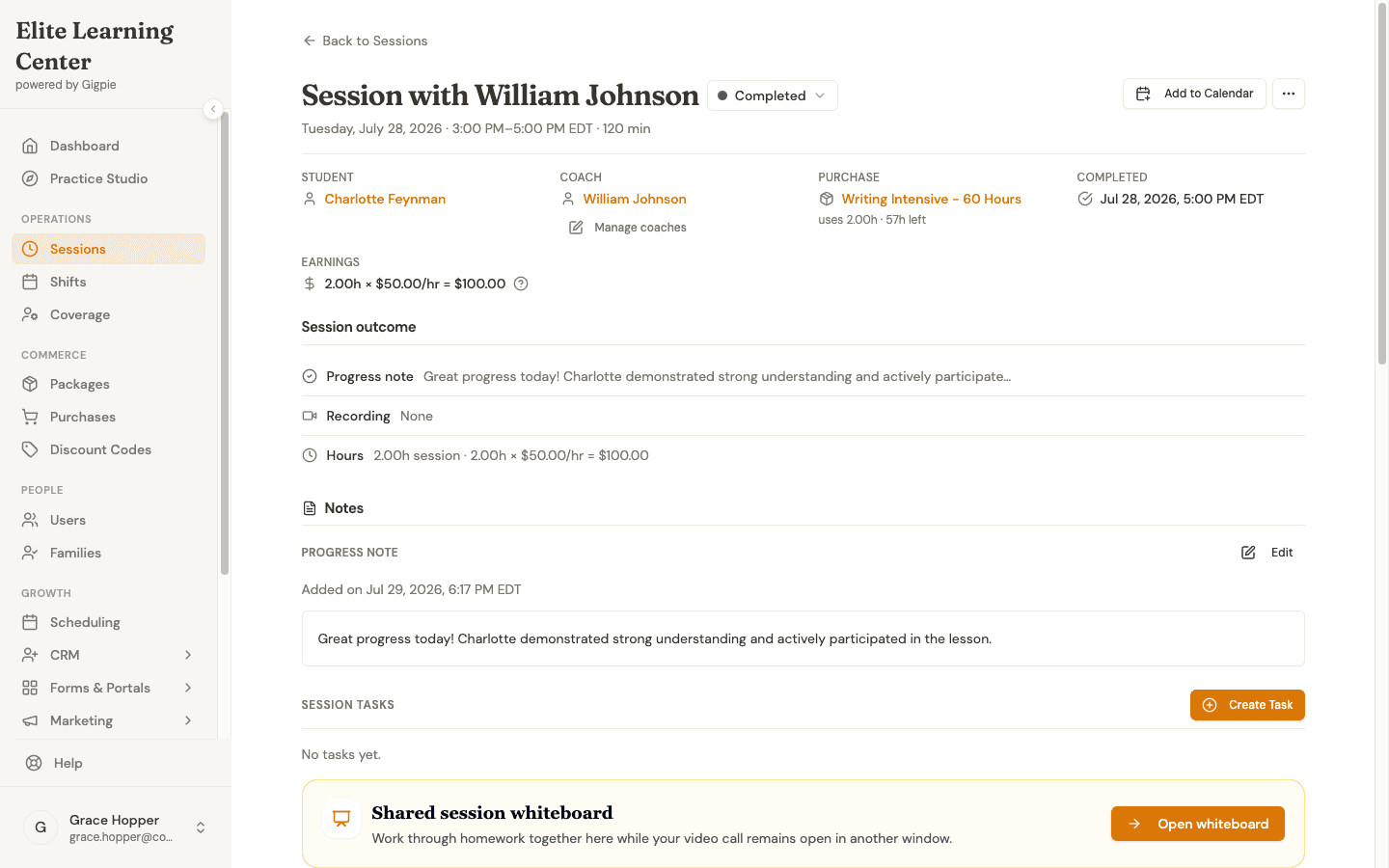 A completed two-hour session: $100 in instructor earnings on the same record as the note the family will read.
Parents see the whole note in the portal, not an excerpt, the moment the session is marked complete.
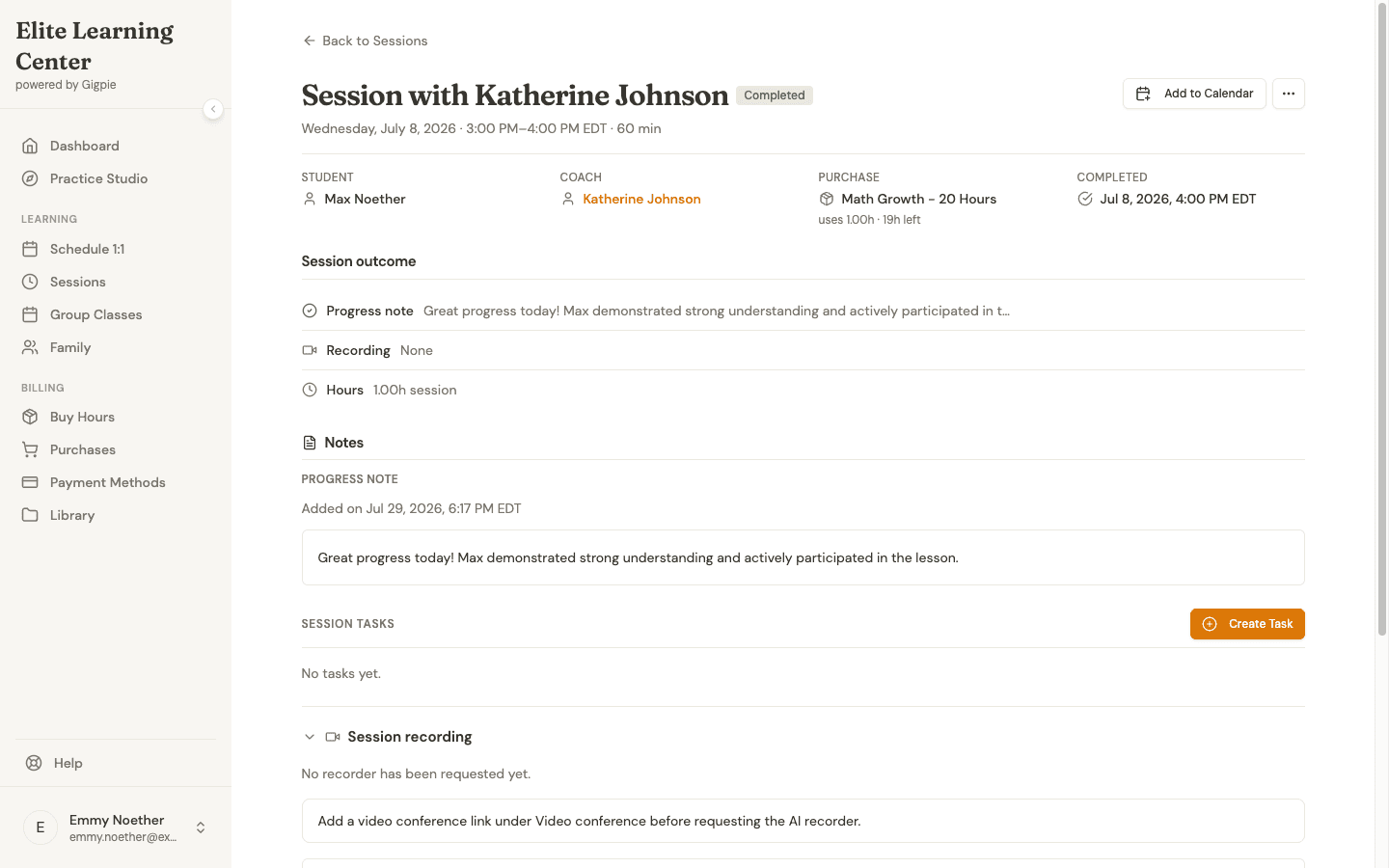 The same session from the parent's portal: the full note, exactly as the instructor wrote it.
After every completed session, Gigpie asks the family for a one-to-five-star rating and a comment. Five-star responses get pointed at your Google or Trustpilot review page (a settings dropdown can widen that to 4), so reviews accumulate during the season you are busiest.
The fee math is flat: 2% of what you collect, and nothing else. An $1,800 intensive package costs $36. A $15,000 October costs $300, and a dead December costs $0. There are no per-instructor seat fees, so staffing up for the spring rush does not change the bill.
Where Gigpie Stops
Gigpie does not talk to the College Board or the ACT. Registration and test-day logistics stay between the family and the testing agency. It does not predict official scores either: an attempt's score is a real number from a real question set, and what that implies for test day is a judgment your instructors make, not an algorithm. There is no native phone app; everyone uses the web app, which works in any mobile browser. And if you are a solo tutor prepping a handful of students a year, most of this machinery is furniture. A calendar and a folder of PDFs may honestly serve you fine until you have instructors to staff and more than one family buying big packages.
Getting Started
- Create your account and connect Stripe. Onboarding runs through Stripe Connect, and Gigpie is free until you collect revenue.
- Build your packages. Intensive blocks and hourly bundles at whatever prices you charge today.
- Invite your instructors. They set weekly availability once, with a live preview of exactly what families can book.
- Author your first question set in Practice Studio and assign it as a diagnostic.
These guides show the day-to-day workflows, recorded from the product:
For educators:
- Schedule a Session - Book one-off or recurring sessions
- Mark Session Complete & Add Notes - Close out a session and write the note
- Claim Marketplace Shifts - Pick up open sessions during the rush
For parents:
- Enroll in a Group Class - Join an open strategy class
- Managing Recurring Sessions - See and manage a standing weekly series
- Review Progress Notes - Read the full note after each session
Frequently Asked Questions
Does Gigpie include SAT or ACT practice questions?
Yes, through the catalog: Practice Studio imports from five tracked sources, including an SAT question bank and the College Board Educator Bank, straight into your company library, where you review and publish before a student sees any of it. You can also write your own from scratch, or mix both. Evallo takes a different approach, advertising 3,000+ practice questions bundled with its subscription as of August 2026, with no review step of its own.
Can I run timed practice tests?
Yes. A question set can carry a time limit and be assigned either as untimed practice or as a timed test. Each attempt records the student's answers and elapsed time, and comes back scored with the instructor's feedback attached.
Can siblings prepping for different tests share one package?
Yes, and this is structural, not a workaround. Packages belong to the family, so an SAT junior and an ACT sophomore draw from the same pooled balance. Gigpie does not enforce per-child hour splits; the balance is shared, and every session records which student used it.
How do I schedule a two-week bootcamp?
Create a session series: pick the days of the week and an ending, either a session count or a date, and the whole block books at once. If it needs to move later, a bulk edit changes up to 100 sessions in one pass and asks for a reason, so there is an audit trail.
Can I mix group classes with private tutoring?
Yes. Group sessions have their own capacity and enrollment rules, from open enrollment with drop-in pricing to package-holders only. Private sessions draw hours from the family's package alongside them.
What happens when a student no-shows the week before the test?
The default policy has teeth: a student no-show or late cancel still consumes the package hour, and the instructor is still paid. If the instructor is the one who misses, it reverses: the family is not charged and the instructor is not paid.
Does Gigpie track or predict official SAT scores?
No. Practice Studio scores every attempt against your question sets, but it does not project official scores or import them from the College Board. Test-day predictions stay with the instructor who knows the student.
What does Gigpie cost?
A flat 2% of what you collect from families. No monthly fee, no per-instructor seat fee, and it is free until you collect revenue, so a slow month costs you nothing.
Run your prep season on one system
Free until you collect revenue, then a flat 2% of what families pay you. Add instructors for the spring rush without adding a bill.
Get startedRelated Resources
- Gigpie vs Evallo - How Practice Studio's author-your-own pipeline compares with Evallo's bundled question bank and per-product subscriptions
- Family Management - The shared-balance architecture that lets two siblings prep for different tests on one package
- Practice Studio - The full authoring, review, and grading pipeline behind the questions this page describes