
Pay by Bank: How Gigpie's 2% Pays for Itself
Card processing takes 2.9% + $0.30 of every payment. Pay by bank costs 0.8% capped at $5, and moving families over saves more than Gigpie's flat 2% fee.
Take a $1,000 installment by card and $29.30 goes to processing before the money reaches you. The same line repeats on every payment from every family, all year, and most owners file it under the cost of doing business online.
Gigpie's platform fee is a flat 2% of what you collect. Move a payment from card to bank and the processing you stop paying is larger than that 2%, at any payment size. The fee does not disappear; the switch covers it.
The Math
Cards process through Stripe at 2.9% + $0.30. Pay by bank runs on Stripe's standard ACH rate: 0.8%, capped at $5, so every payment of $625 or more costs exactly $5 to process.
| Payment | Card (2.9% + $0.30) | Bank (0.8%, $5 cap) | Processing saved | Gigpie's 2% |
|---|---|---|---|---|
| $500 | $14.80 | $4.00 | $10.80 | $10.00 |
| $1,000 | $29.30 | $5.00 | $24.30 | $20.00 |
| $2,500 | $72.80 | $5.00 | $67.80 | $50.00 |
The pattern holds at every size. Below $625, the saving is 2.1% of the payment plus $0.30, always more than 2%. At $625 and above, the bank fee is a flat $5, so the saving is 2.9% + $0.30 minus $5, which beats 2% on any payment over $523, and the gap grows with the payment.
This is an offset, not a rebate. You still pay the 2% on every payment, card or bank. The claim is narrower: each payment a family moves to bank saves you more in processing than the 2% on that payment costs.
How Families Actually Pay by Bank
A parent picks their bank from a list and signs in to it. Stripe Financial Connections verifies the account on the spot, so nobody types routing numbers and nobody waits days for micro-deposits to land. From then on, the saved bank account behaves like a saved card: it works at checkout, and autopay can charge it on each installment's due date.
The real difference is clearing time. ACH takes a few business days, so Gigpie tracks in-flight transfers in a dedicated processing status, and autopay schedules around clearing windows instead of marking a slow transfer failed. Parents and admins both see Stripe's expected clear date on that transfer, an estimate Stripe updates as the transfer moves, not a guarantee.
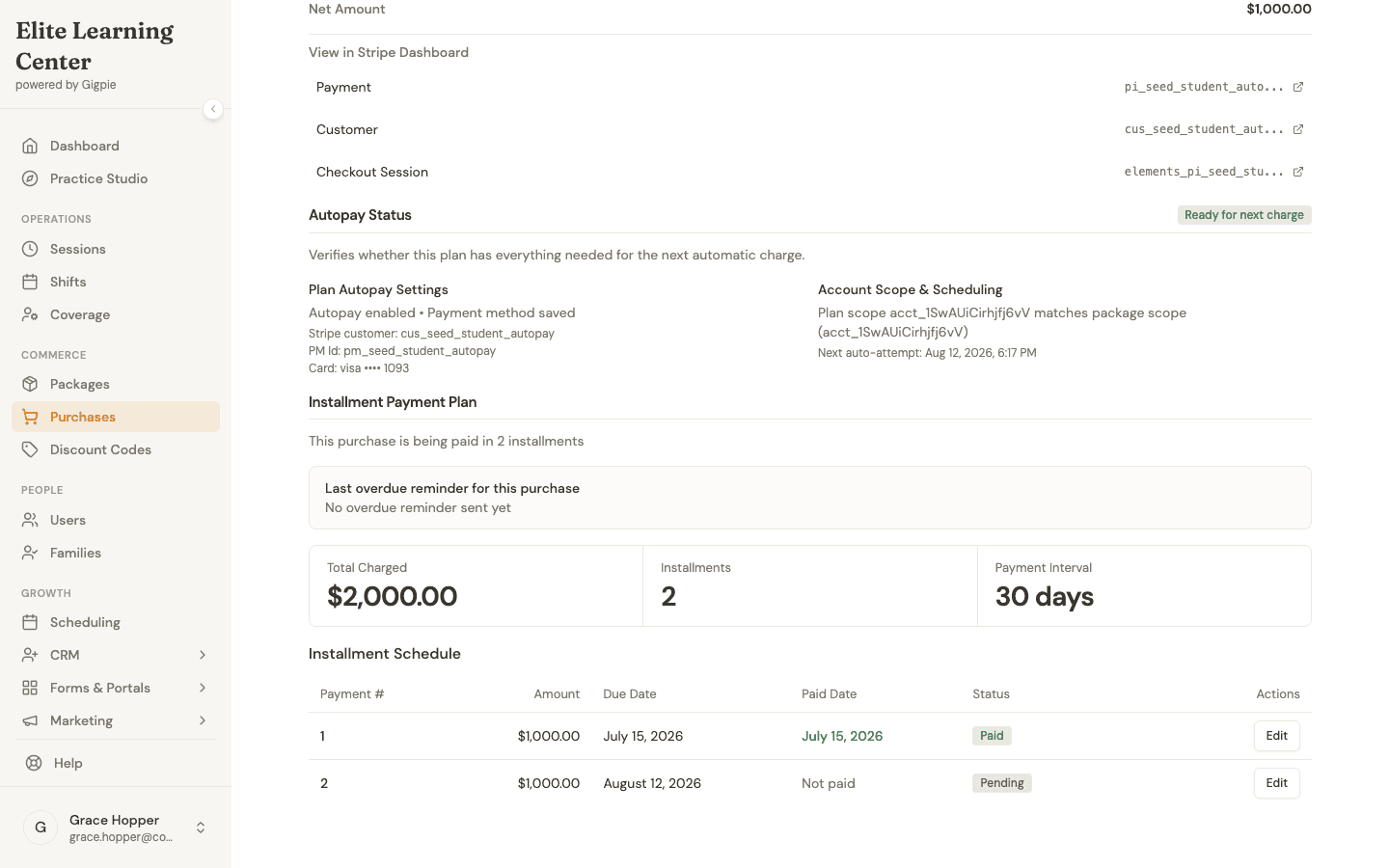 Autopay ready for the next $1,000 installment; a saved bank account runs this charge the same way a saved card would.
The Card Surcharge Lever
Some parents will keep the card for the points. Where card-network rules allow it, Gigpie adds a configurable surcharge to card payments, 3% by default, with bank payments left at zero. A parent who insists on the card covers their own processing; a parent who switches pays nothing extra.
One wrinkle to know before you turn it on: the 2% applies to the gross the parent pays. A $1,000 package with the 3% card surcharge charges the parent $1,030, and the platform fee comes to $20.60 instead of $20. The surcharge moves $30 of processing off your books and adds 60 cents of fee.
Frequently Asked Questions
Do parents push back on paying by bank?
Connecting takes about a minute: pick the bank from a list, sign in, done. Nobody types routing numbers. Some parents still want card rewards, and the surcharge handles that: with the 3% default on, a $1,000 installment costs the parent $30 more by card than by bank, which makes the case for them.
How long does a bank payment take to clear?
A few business days, which is standard ACH. Gigpie tracks in-flight transfers in a dedicated processing status, and autopay respects clearing windows rather than flagging a slow transfer as failed.
What if a family insists on paying by card?
They always can. The surcharge is configurable per company: keep the 3% default so card users cover their own processing, set a different rate, or turn it off and absorb card fees the way you do today.
What happens if an ACH charge fails?
Autopay retries it without double-billing the family, and the installment stays marked due until a charge clears. A slow transfer is tracked as processing, which is different from a failed one.
Is 2% of collections really cheaper than a subscription?
It depends on your revenue, and at high enough collections a flat subscription wins in raw dollars. We publish worked break-even math against named products on our compare pages, linked below under Related Resources. This page's argument is separate from that comparison: whatever the 2% costs you in dollars, payments that move from card to bank save more than that amount.
Pay 2%, save more than 2%
A flat 2% of collections, nothing until revenue moves, and processing capped at $5 when families pay by bank.
Get started freeRelated Resources
- Pricing - The flat 2% explained end to end, with a calculator that runs it at your revenue.
- Billing & Payments - The machinery underneath this page: packages, installments, autopay, and no-login checkout.
- Compare Gigpie - Break-even math against TutorBird, Teachworks, TutorCruncher, and the rest, with every competitor named.