
What to Pay Tutors: A Rate-Setting Framework That Starts From Your Parent Rate
A decision framework for setting tutor pay: work backward from your parent rate, weigh subject scarcity and credentials, price group sessions correctly, and keep raises affordable.
Here's how most owners set a tutor pay rate: check a couple of job boards, ask a friend who runs a center two towns over, and pick a number that sounds fair. The problem isn't that those numbers are wrong. It's that none of them know what your parents pay you. A pay rate copied from a job board can be perfectly normal for the market and still quietly unaffordable for your business, or insultingly low for the tutors your positioning requires.
You'll notice this guide doesn't tell you that tutors should get some standard percentage, and that's deliberate: the benchmark numbers floating around the internet are unsourced, and a made-up benchmark is worse than none. What we can give you is the framework: the arithmetic that tells you what you can afford, and the four levers that tell you where within that range a given tutor should land.
Start From the Split, Not the Rate
Every dollar a parent pays you gets divided, whether you plan the division or not. Tutor pay is one share. The others are the cost of getting that parent in the door (marketing, trial sessions, your unpaid sales calls), the cost of delivering the session (software, space if you have it, admin time), taxes, and your margin. Written as arithmetic:
Parent rate − tutor pay − delivery costs − acquisition costs = your margin.
The reason to set pay as a share of the parent rate, at least mentally, is that this identity stays visible. If a parent pays $80/hour and the tutor gets $40, you know each hour leaves $40 to cover everything else, and you can check whether it actually does. If instead you hire at a flat rate you saw on a job board, the identity still exists; you just haven't looked at it, and the first time you do is often when a busy month somehow produces no profit.
Two failure modes to avoid. Setting the tutor share too thin saves money for a while and then charges it all back at once: your strongest tutor leaves, taking families with them, and you discover replacement costs (recruiting, onboarding, re-matching upset families) that never appeared on any spreadsheet. Setting it too generously feels virtuous until you realize the leftover share can't fund the marketing that keeps those tutors' schedules full. The right split is the one where both sides of the identity work: tutors you can keep, and a remainder that covers your costs with margin left.
Whether that share is paid literally as a percentage or converted into an hourly number is a mechanics question; our guide to paying tutors covers those structures and their trade-offs. What matters here is that the number came from your parent rate, not someone else's.
The Four Levers That Move a Tutor's Rate
Within what your parent rate supports, four things justify paying one tutor more than another.
Subject scarcity
The scarcer the credible supply, the higher the share. Plenty of people can support elementary reading homework; far fewer can teach AP Physics C or upper-level math well enough that parents notice the difference. Scarcity also protects you on the revenue side, since scarce subjects command higher parent rates. The two move together, which is another argument for thinking in shares: a specialist teaching at your highest parent rate can earn meaningfully more per hour than your generalists at the identical split.
Credentials and proof
Parents pay for evidence: a certified teacher, a tutor with verifiable score improvements, someone with years at a known program. If a tutor's credentials let you charge more or close families faster, some of that value belongs in their rate. The discipline is to pay for proof that shows up in your revenue, not for credentials that impress you but don't move parents.
Group versus one-on-one
Group sessions change the per-hour math completely, and pay should reflect it. Four students at $40 each is $160 of revenue for one tutor hour. You can pay that tutor more per hour than any one-on-one slot pays, charge each family half your private rate, and still keep more per hour than you do on private sessions. The trade is that group teaching is harder: managing four kids at four paces is a skill, and the tutors who have it should see it in their rate. A concrete version of this math is in the worked example below.
Your market
Regional variance is real, but resist the urge to resolve it with a number from a national article. Your market sets two local facts: the ceiling on what parents will pay, and the floor below which credible tutors won't work, both shaped by the local cost of living and by who else is hiring them. Online tutoring blurs the edges in both directions, letting you hire from cheaper markets and letting your best tutors defect to platforms that serve expensive ones. The practical move is local research: what do the tutoring businesses in your area charge parents, and what are they offering tutors right now? Those two numbers, this month, in your zip code, beat any national average.
The Worked Example: Parent Rate to Pay Rate to Fees
Concrete numbers, using Gigpie's actual pricing, since software fees belong in the identity too.
A family buys a 10-hour package at your $80/hour parent rate: $800 collected. Gigpie's fee is a flat 2% of what you collect, so $16. Suppose your tutor's share works out to $40/hour, so $400 across the package. What remains:
$800 − $400 (tutor) − $16 (platform) = $384 for acquisition, admin, taxes, and margin.
Now the two ways a raise can happen. If you move the tutor to $44/hour with prices unchanged, the remainder drops to $344; the raise came out of your share. If instead you raise the parent rate to $90 and keep the 50% share, the next 10-hour package collects $900, the fee is $18, the tutor earns $450, and the remainder grows to $432. Same raise for the tutor, opposite effect on you. This is the single best argument for revisiting parent rates and pay rates together instead of negotiating them in separate conversations.
The group version: a 4-student group class at $40 per student per hour collects $160/hour. Pay the tutor $50/hour, which beats their private-session rate, and the fee is $3.20, leaving $106.80 per hour against costs, versus $38.40 on the private-session example above. Groups are how tutor raises and parent price cuts coexist.
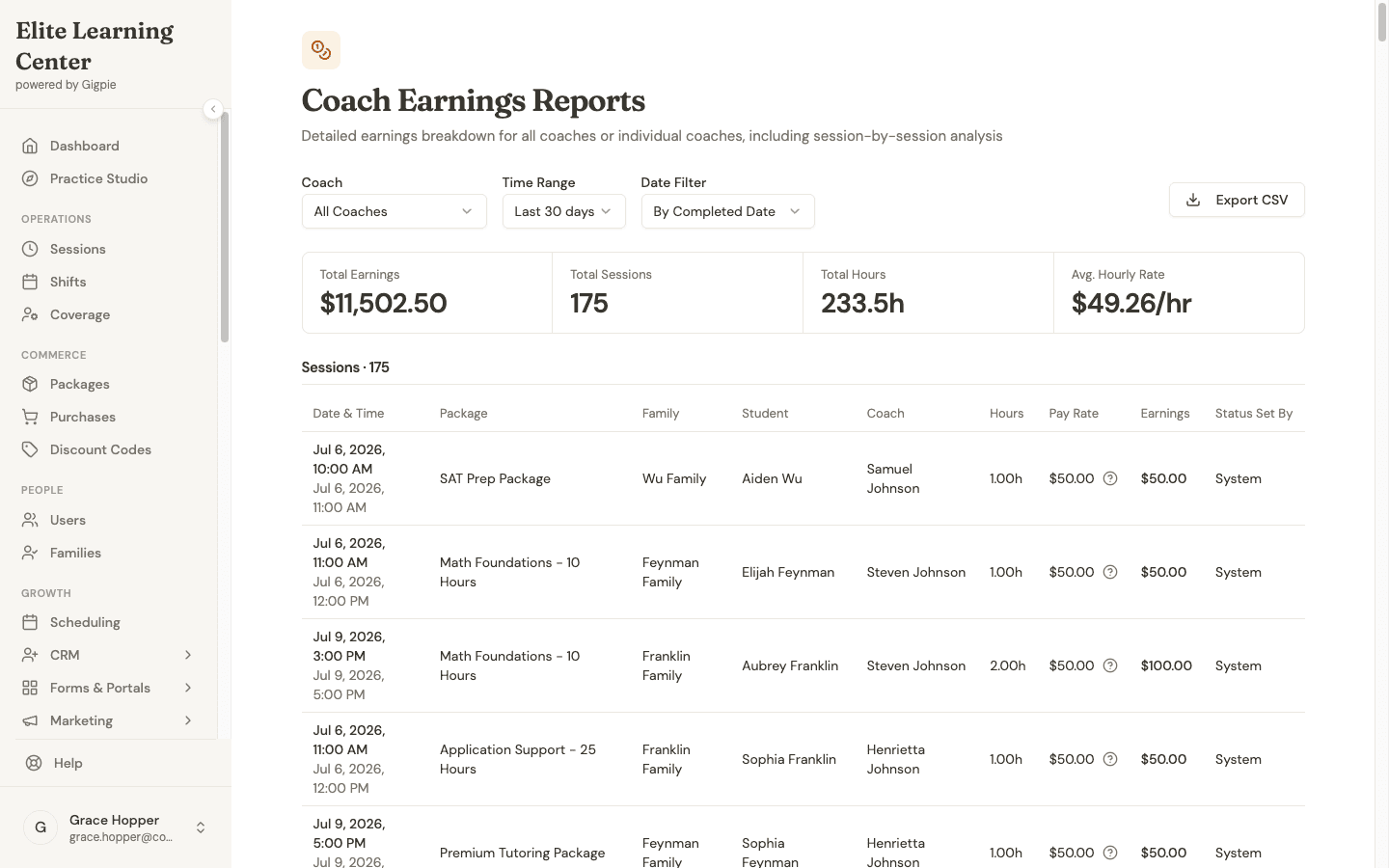
175 sessions and $11,502.50 of tutor pay in one month, broken out per coach and per rate: the report that shows whether your splits are holding.
When to Raise a Rate (and When You Can't)
Raise proactively when a tutor has become hard to replace: full schedule, families who ask for them by name, a subject you can't easily re-staff. The replacement cost of that tutor never appears in your books until they leave, at which point it appears everywhere at once.
When a raise request arrives and the current parent rate can't fund it, say that with the numbers on the table. "Your share of the $80 rate is $40; I can get you to $45 when we move families to $90 in September" is a conversation that keeps good tutors, because it's a plan instead of a no. Percentage splits automate this whole dynamic, which is their strongest argument: every parent-rate increase is a raise, with no meeting required.
Mechanically, make raises effective at a pay-period boundary. Gigpie's payroll runs snapshot the rate in effect when each session was delivered, so a mid-period change doesn't rewrite sessions already taught, but clean boundaries make for cleaner conversations. And if you're setting rates as part of bringing new tutors on, the hiring guide covers the recruiting side, while the classification decision determines the employer costs that sit on top of whatever rate you agree to, so settle it before you quote a number.
Frequently Asked Questions
What percentage of the parent rate should tutors get?
There's no defensible universal number. Solve your own identity instead: parent rate minus your real per-hour costs (acquisition, admin, software, taxes) minus the margin you need equals the most you can pay. If that number is below what credible tutors in your market accept, the fix is usually your parent rate, not more searching for cheaper tutors.
Should online tutors be paid less than in-person tutors?
Not by default. Online delivery removes travel and space costs, which changes your side of the identity, but the tutor's hour is the same hour. What moves the number is the market: online lets you hire beyond your zip code, and lets your tutors work beyond it too. Pay what retains the tutor you want against their real alternatives.
Should group-class tutors earn more per hour?
Usually yes. A 4-student group at $40 per student collects $160/hour, so paying the tutor above their one-on-one rate still leaves you more per hour than a private session does. Group teaching is also genuinely harder to do well. Underpaying for it pushes your most capable tutors back toward private sessions, which is the opposite of what your economics want.
Do I pay tutors for prep time?
The expensive answer is the one you never gave. Build prep into the session rate, pay a flat weekly amount per student, or pay hourly for approved non-teaching work; any of the three beats silence, where tutors either do unpaid prep and resent it or stop prepping and quality slides.
A tutor asked for a raise I can't afford. Now what?
Check whether the parent rate has room before you answer. If it does, raise both together and the raise funds itself; if it doesn't, show the tutor the math and a timeline. A specific plan tied to a price change keeps more good tutors than a vague yes that quietly breaks your margin.
How does Gigpie's fee affect what I can pay tutors?
Gigpie charges a flat 2% of what you collect, and it's free until you collect revenue. On an $80 session that's $1.60, sized to sit inside the identity without bending it, and there are no per-tutor seat fees, so adding your ninth tutor costs the same as your first: 2% of whatever they help you collect.
See what every tutor earned without rebuilding the math
Per-coach, per-rate earnings from sessions actually delivered, and payroll exports ready for your processor. Free until you collect revenue, then a flat 2%.
Get started freeRelated Resources
- How to Pay Tutors - Pay structures, no-show pay rules, and running payroll as calculate, approve, export
- 1099 or W-2 for Your Tutors? - The classification call that sets the employer costs above your pay rate
- Educator Payroll - Pay groups, rate snapshots, and the earnings report shown in this guide
Ready to grow your tutoring business?
Free until you collect revenue. Put these insights into action with Gigpie.
Get started free