
TutorBird Alternatives: 5 Options Compared (2026)
TutorBird's $16.95 plan, checked against five real alternatives with verified August 2026 pricing, what each one is actually for, and the case for staying put.
TutorBird costs $16.95 a month plus $4.95 per additional tutor, with unlimited students, as of August 2026. That price buys real software: scheduling with two-way calendar sync, invoicing with Auto-Pay, a working parent portal, and automated multi-tutor payroll. People who search for a replacement anyway usually have one of three reasons. Their business has outgrown tutoring-only software and the marketing, lead follow-up, and review collection now live in separate tools. Their billing revolves around families with siblings, and they want package hours pooled at the household level. Or they want a different pricing shape entirely, one that scales with revenue instead of headcount.
A warning about this genre before the list: most "TutorBird alternatives" pages are wrong about TutorBird. Some still cite $29 to $99 tiers with student caps that don't match its published pricing, or claim it lacks calendar sync and automated billing. An earlier version of our own comparison page made both mistakes. Every claim below comes from each vendor's own public pages, checked August 5, 2026.
What TutorBird Gets Right
If you're leaving, know what you're giving up. TutorBird's Google Calendar and iCalendar sync is genuinely two-way: lessons flow to a tutor's personal calendar and personal events flow back to block double-booking. Auto-Pay charges a family's saved card through Stripe or PayPal the moment an invoice goes out. The student portal handles self-service booking, online bill pay, homework submission with file uploads, and admin-approved tutor reviews. Multi-tutor payroll calculates automatically, as a flat hourly rate or a percentage of tutor-generated revenue. There's phone support in the US/Canada, UK, and internationally, plus a 30-day trial and a 90-day money-back guarantee. For a tutoring operation that needs exactly this scope, it's hard to beat on price.
What to Look For in an Alternative
Four questions separate a good switch from an expensive lateral move.
Scope. If the reason you're shopping is everything around the tutoring, a lead pipeline, email campaigns, review collection, then a replacement that only reshuffles scheduling and invoicing solves nothing. Ask what the new platform absorbs from the rest of your stack.
Data exit, on both ends. TutorBird doesn't publicly document a self-service data export. Third-party migration tools advertise importing TutorBird CSVs, which suggests your data can come out, but confirm with TutorBird support before you commit anywhere. Ask the same question of the platform you're moving to; you may leave it someday too.
Family billing mechanics. TutorBird has a Family Account for consolidated billing and supports sibling discounts. Whether one package's hours can be shared across siblings isn't documented publicly. If two kids drawing from one prepaid balance is your reality, test that exact flow in a trial before signing up.
Pricing shape. Per-seat flat fees, a percentage of collections, and per-lesson metering each punish a different growth pattern. A per-seat model gets cheaper relative to revenue as you grow; a percentage model stays proportional; per-lesson pricing tracks volume. Pick the one that matches how your business actually expands.
The Alternatives
1. Gigpie
Gigpie covers TutorBird's core, then extends into the business around it: a CRM with lead capture, a pipeline board, and an inbox that threads email, SMS, and calls together; broadcast and multi-step journey campaigns; an AI phone agent for inbound calls; and a post-session feedback funnel that routes 4- and 5-star families toward Google, Trustpilot, and Thumbtack reviews. Billing is built around the family: a package belongs to the household, and any sibling draws from the same hour balance without configuration.
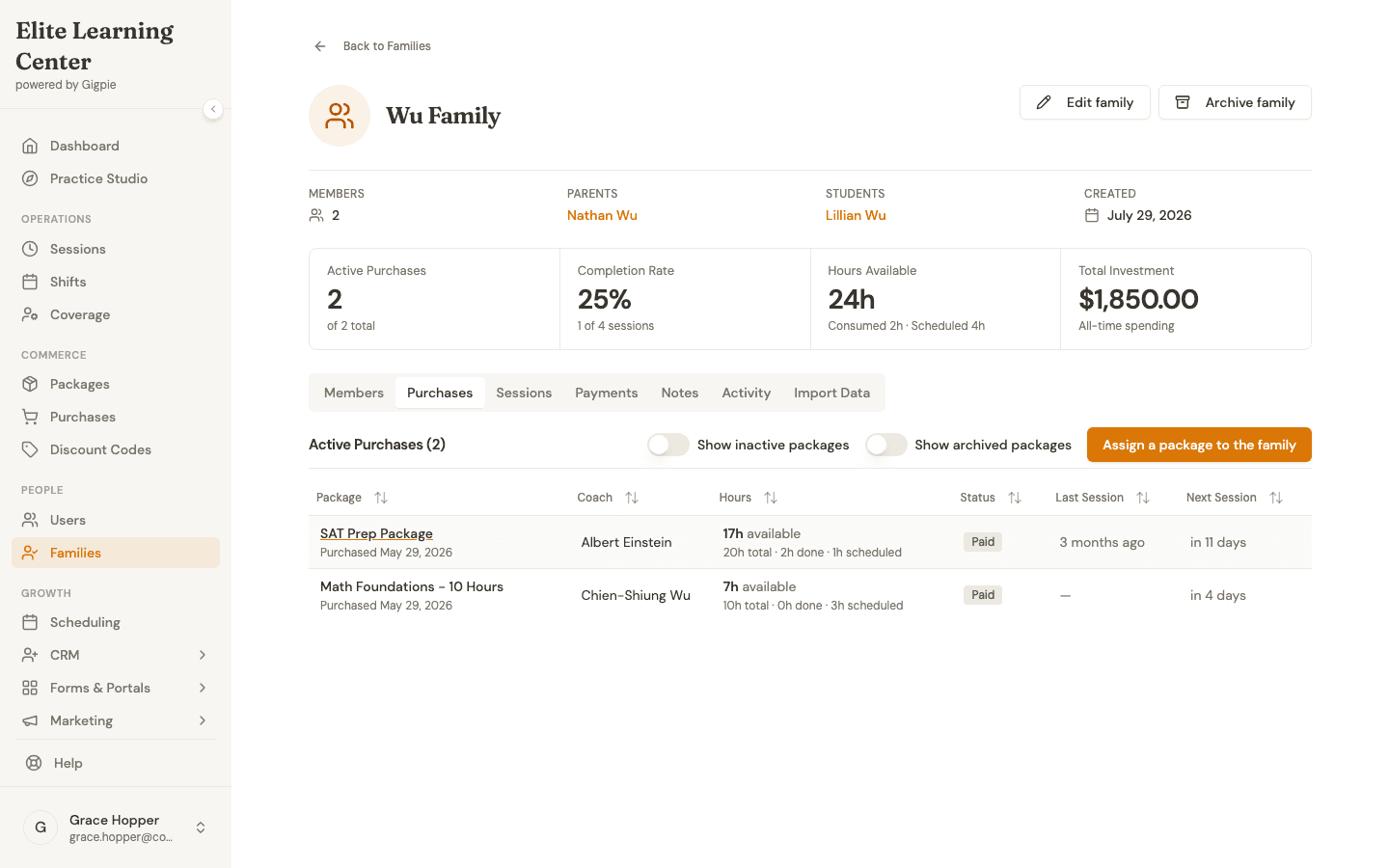 One family, 24 hours across 2 packages, and a single balance the household draws from.
Pricing is a flat 2% of what you collect, free until you collect revenue. But the advantage has a limit: a solo tutor collecting $3,000 a month pays TutorBird $16.95 and Gigpie $60, and a five-tutor center collecting $20,000 pays TutorBird $36.75 and Gigpie $400. If tutoring software is the only line item you're replacing, TutorBird wins that comparison at any healthy revenue level. Gigpie's 2% makes sense when it also retires the email tool, the missed-call problem, the review chasing, and the payroll spreadsheet.
2. Teachworks
Teachworks prices by usage instead of seats: Starter is $16.49 a month plus $0.32 per student lesson, Growth is $47.99 plus $0.189, and Premium is $187.99 plus $0.065, with unlimited tutors and students on every tier as of August 2026. That shape favors teams that add staff often, since headcount never raises the bill. Know that several conveniences are paid add-ons, including two-way Google Calendar sync and client self-serve booking and cancellation. It fits established centers with steady lesson volume and an admin comfortable assembling the configuration they need.
3. TutorCruncher
TutorCruncher starts at $30 a month plus roughly a 1% revenue fee in the US (£25 in the UK), rising to $240 for the Enterprise tier with API access, as of August 2026. It's built for agencies: automated tutor payouts through Stripe, split payments that divide an invoice between agency commission and tutor pay, and documented CSV exports for students, tutors, lessons, and invoices. If you run a placement-style agency and want the platform to actually move money to tutors, it's the strongest option on this list for that specific job.
4. Tutorbase
Tutorbase charges no subscription at all; the platform is free and takes 1% when you create invoices through it, as of August 2026. It has two-way Google Calendar sync (Google only, no Outlook), package billing with real-time balance tracking, a lead pipeline with WhatsApp capture and two-way WhatsApp messaging, and automated payroll calculation with a review step. Its team advertises done-for-you data migration during a three-week onboarding. It fits price-sensitive centers and businesses in markets where families live on WhatsApp.
5. My Music Staff
My Music Staff will feel familiar to a TutorBird user: the pricing is the same $16.95 a month plus $4.95 per additional teacher, with a 30-day trial and 90-day money-back guarantee, as of August 2026. The difference is specialization. Students get a practice log with a built-in timer, file uploads for practice videos, and lesson resources like sheet music. If you run a music studio and TutorBird's general-tutoring framing never quite fit, this is the direct swap to evaluate first.
Before You Switch: The Migration Reality
Plan the exit before you pick the destination. Since TutorBird doesn't publicly document what you can export, call its support line and get a specific answer about students, families, balances, and history. Whatever you're promised, a few items rarely make the trip on any platform change: session history rarely imports cleanly into a new system, old invoices live on in the old system for your records, and saved payment methods with autopay enrollments get rebuilt from scratch, which means asking parents to re-enter cards once.
On the destination side, Tutorbase advertises staff-done imports. Gigpie has no automated importer for any outside platform yet; moving from TutorBird means re-entering families, packages with remaining hours, and schedules by hand, so schedule the work between terms rather than mid-semester.
Frequently Asked Questions
Why do people look for TutorBird alternatives?
The common searches are about scope and structure, not quality. Businesses outgrow tutoring-only software when marketing, lead follow-up, and reviews start living in separate tools; families with siblings want pooled package hours; and some owners prefer pricing tied to revenue or lesson volume instead of tutor headcount. TutorBird itself is mature, actively maintained software.
Can I export my data from TutorBird?
TutorBird doesn't publicly document a self-service export as of August 2026. Third-party migration tools advertise importing TutorBird CSVs, which suggests exports are possible, but call TutorBird support and confirm exactly what you can get out before committing to a move.
Am I locked into a TutorBird contract?
TutorBird bills monthly at $16.95 plus $4.95 per additional tutor, and its pricing page advertises a 90-day money-back guarantee for new accounts as of August 2026. No annual lock-in appears on its published pricing.
Should I switch platforms mid-semester or between terms?
Between terms, almost always. Mid-semester you're carrying active packages with partial balances, autopay schedules, and booked sessions, all of which must be recreated on the new platform without billing anyone twice. A term break gives you a clean cutover date and time to run both systems briefly.
Which TutorBird alternative is cheapest?
It depends on your shape. Tutorbase's 1% of invoiced revenue is the lowest percentage model. TutorBird's own $16.95 plus $4.95 per tutor is often the smallest absolute bill. Gigpie's 2% of collections only beats TutorBird's price below roughly $850 a month in collections for a solo tutor; above that, you'd choose Gigpie for scope, not price.
Do any of these alternatives have a native mobile app?
No. As of August 2026, neither TutorBird nor any platform on this list ships an iOS or Android app. All of them, Gigpie included, are responsive web apps you can pin to a phone home screen. Any comparison page claiming otherwise is worth double-checking.
Does Gigpie import TutorBird data automatically?
Not yet. Gigpie has no automated importer for TutorBird or any other outside platform. A TutorBird migration means re-entering families, packages with remaining balances, and schedules manually. Session history and past invoices stay in TutorBird.
Will parents have to re-enter their payment details after a switch?
Plan for it. Saved cards and autopay enrollments are tied to the platform and payment setup they were created in, and none of the vendors here documents importing another product's stored payment methods. The practical move is one clear email to families with a link to add a card on the new system.
What does Gigpie include that TutorBird doesn't?
A CRM with lead capture and a pipeline board, a unified inbox for email, SMS, and calls, broadcast and journey email campaigns, an AI phone agent, and a post-session feedback funnel that routes happy families to Google, Trustpilot, and Thumbtack. None of these appear in TutorBird's documented feature set as of August 2026. TutorBird counters with phone support and a lower bill at most revenue levels.
Are the $29-to-$99 TutorBird tiers I've seen on other sites real?
Not anymore, if they ever were. TutorBird's published pricing as of August 2026 is one plan: $16.95 a month for the first tutor, $4.95 for each additional tutor or staff member, unlimited students. Pages citing Basic, Professional, or Business tiers with 30, 100, or 300 student caps are describing a product that doesn't match the current site.
Which alternative is best for a music studio?
Start with My Music Staff: same pricing shape as TutorBird, plus practice logs, file uploads, and lesson resources built for music teaching. Consider Gigpie instead if the studio also needs family-shared package balances across siblings or a CRM for inquiries and re-enrollment campaigns.
Run Gigpie alongside TutorBird before you decide
Set up your families and packages, test a week of real scheduling, and keep TutorBird running until you're sure. Nothing is owed until you collect revenue, and the fee afterward is a flat 2% of collections.
Get started freeRelated Resources
- Gigpie vs TutorBird - The full head-to-head: an 18-row feature table and break-even math at three revenue levels.
- Family Management - How one package serves a whole household, the mechanic TutorBird doesn't document.
- Best Tutoring Software 2026 - The wider field beyond these five, with verified pricing throughout.