
Teachworks Alternatives: 5 Options Compared (2026)
Teachworks' per-lesson meter, checked against five real alternatives with verified August 2026 pricing, who each one actually fits, and the worked math on when switching pays.
Teachworks has run tutoring back offices since 2014, and its pricing meters by usage: Starter is $16.49 a month plus $0.32 per student lesson, Growth is $47.99 plus $0.189, and Premium is $187.99 plus $0.065, with unlimited tutors and students on every tier as of August 2026. The people typing "Teachworks alternatives" into a search box tend to want one of two things. Some want the features they use daily, client self-serve booking, cancellation, two-way calendar sync, included in the base product rather than sold as separate add-ons. Others want the meter moved: per-lesson pricing means the bill tracks session volume, and a high-volume, lower-priced program can pay more than a boutique billing twice the revenue.
There's a third, quieter trigger: mobile. Teachworks has no native app, and "Make an app" sits atop its public feature-request board marked not planned. As you'll see below, that turns out to be a poor reason to switch, because nobody else on this list has one either.
What Teachworks Gets Right
Everything here is from Teachworks' own pages, checked August 5, 2026. Unlimited teachers on every tier means a $16.49 entry price that never rises when you hire, a structure almost nobody else in the category matches. Stripe billing is genuinely automated: clients save cards and get auto-charged, invoices can generate themselves on a schedule with the Invoice Autopilot add-on, and staff can bulk-charge outstanding invoices. Payroll pulls teacher hours straight from the calendar, with wage tiers for paying different rates on the same service. It integrates with QuickBooks Online, offers an API on Growth and Premium, and supports live chat plus an around-the-clock AI support agent. Spreadsheet imports for students, families, and employees are documented, so getting data in is straightforward.
What to Look For in an Alternative
Add-ons change what you actually pay. Two-way Google Calendar sync, client lesson requests, website booking, customer cancellation, and results tracking are each paid add-ons at Teachworks. Before comparing any alternative, write down the add-ons you actually run and price the full configuration on both sides.
Where the meter sits. Per-lesson pricing scales with volume: raise your rates and the Teachworks bill stays flat, add lessons and it grows. Per-seat models (TutorBird, My Music Staff) scale with headcount. Percentage models (Tutorbase, Gigpie) scale with money collected. None is universally cheaper; each rewards a different business shape.
Which way the calendar sync runs. At Teachworks, two-way sync is Google-only and paid; Outlook gets a one-way feed out. If your tutors live in Outlook or Apple Calendar, ask any alternative exactly which calendars sync and in which direction, because vendors blur this constantly.
The mobile web experience. No platform in this comparison ships a native iOS or Android app. Judge the thing parents will actually touch: open each vendor's parent portal on a phone during the trial and try to book, pay, and read a lesson note.
The Alternatives
1. Gigpie
Gigpie puts the client-facing basics in the base product: parents book, reschedule, and pay without add-on purchases, and sessions push to both Google and Outlook calendars with a conflict check at booking time. Around that core sit the tools that usually live in other tabs: a CRM with lead capture and a pipeline board, broadcast and journey email campaigns, an AI phone agent, a post-session feedback funnel that turns happy families into Google and Trustpilot reviews, and payroll runs that end in CSVs for your payroll processor. Billing treats the family as the account, so siblings share one package balance automatically.
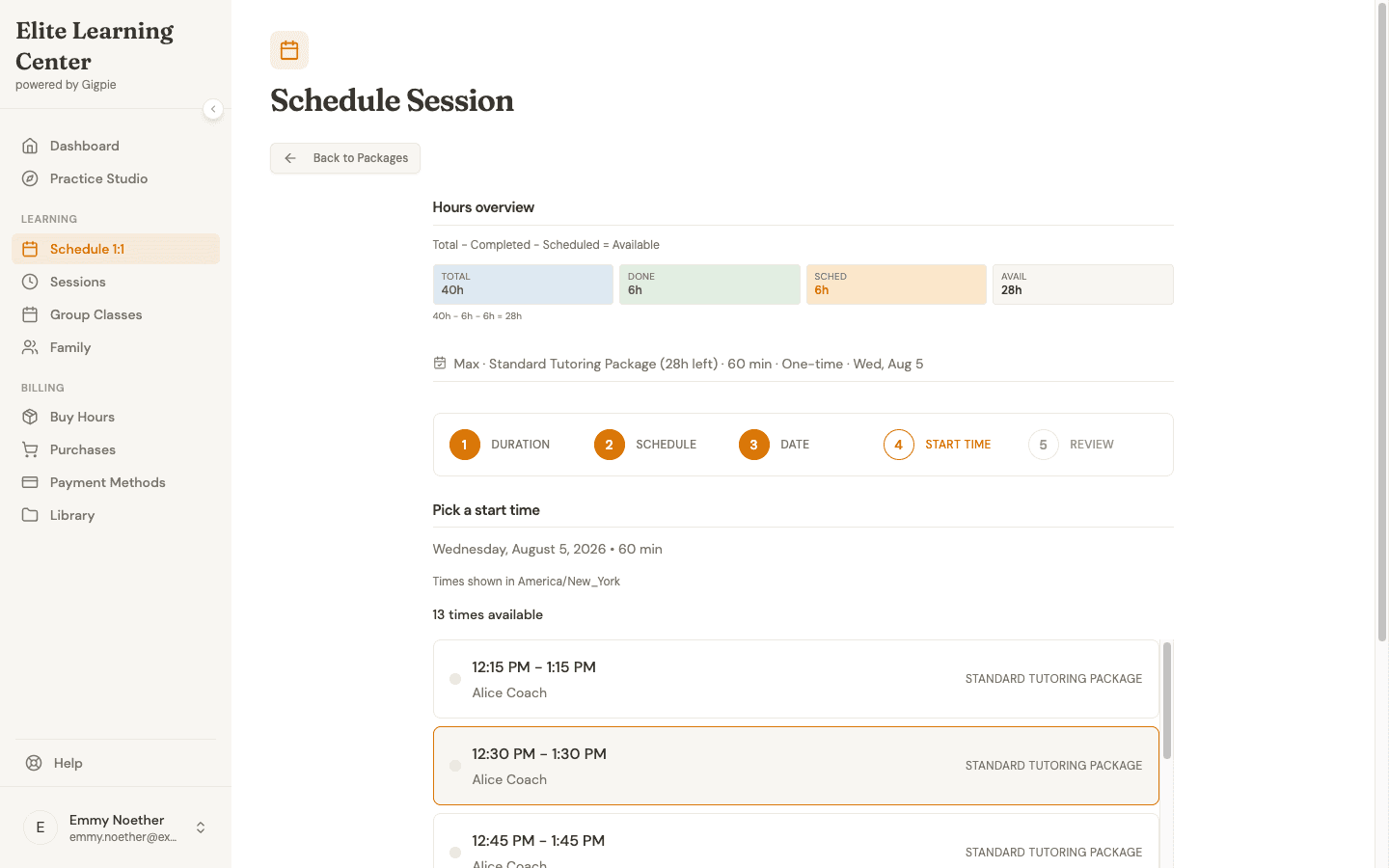 A parent picking from 13 open times. Self-serve booking ships in Gigpie's base product; at Teachworks, client booking and cancellation are paid add-ons.
The fee is a flat 2% of collections, free until you collect revenue. The math against Teachworks, assuming $60 average lessons: at $3,000 a month (about 50 lessons), Teachworks Starter costs $32.49 and Gigpie $60. At $20,000 (about 333 lessons), Growth costs $110.93 and Gigpie $400. The lines cross near $1,100 a month in collections, and above that Teachworks is the smaller software bill. Gigpie fits when the 2% replaces several tools at once; if scheduling and invoicing are genuinely all you need, it's the wrong trade.
2. TutorBird
TutorBird sells one plan, $16.95 a month plus $4.95 per additional tutor with unlimited students, as of August 2026, and the base price includes what Teachworks sells separately: two-way Google Calendar and iCalendar sync, Auto-Pay through Stripe or PayPal, and a portal with self-service booking, bill pay, and homework submission. It adds phone support in three regions and a 90-day money-back guarantee. The trade-off is the meter: each hire adds $4.95 a month. It fits small teams that want the whole bundle at a flat per-seat price.
3. TutorCruncher
TutorCruncher runs $30 a month plus roughly a 1% revenue fee at entry in the US (£25 in the UK), up to $240 for Enterprise with API access, as of August 2026. Its distinctive strength is agency money movement: automated tutor payouts through Stripe and split payments that divide each invoice between agency commission and tutor pay. Calendar integration is a one-way iCal feed rather than two-way sync. It fits agencies that place tutors with clients and want the platform to handle paying them.
4. Tutorbase
Tutorbase drops the subscription entirely: the platform is free and takes 1% when you create invoices, as of August 2026. Two-way Google Calendar sync is included (Google only), package billing tracks balances in real time, and the CRM is WhatsApp-first, with a capture widget and two-way messaging inside the app. Migration is done for you during a three-week onboarding, which Tutorbase advertises as "no data entry." It fits centers that want the lowest fixed cost and communicate with families over WhatsApp.
5. My Music Staff
My Music Staff is the specialist option: $16.95 a month plus $4.95 per additional teacher as of August 2026, with two-way Google and iCalendar sync in the base price, a student practice log with a built-in timer, and lesson resource sharing for sheet music and recordings. A 30-day trial and 90-day money-back guarantee lower the risk of testing it. If your Teachworks account is running a music studio, evaluate this one before the generalists.
Getting Your Data Out of Teachworks
The good news: Teachworks pages and reports download to Excel and CSV, so lesson summaries, revenue, and payroll data can be pulled today, while you still have access. The gap: no full-account export for departing customers appears in Teachworks' public documentation as of August 2026, so ask its support chat what else they can provide, and budget an afternoon for pulling reports section by section.
Expect a rebuild, not a transfer, on a few fronts: parents create new portal logins, saved cards and autopay enrollments are re-entered on the new platform, and session history generally stays behind for reference. Pick Tutorbase and its team does that import work for you; pick Gigpie and there's no automated importer yet, so a Teachworks migration means keying in families, packages with remaining balances, and schedules, which is why a term break beats a mid-semester cutover.
Frequently Asked Questions
Why do people search for Teachworks alternatives?
Three patterns dominate: wanting client booking, cancellation, and two-way calendar sync in the base product instead of as paid add-ons; preferring a bill that tracks revenue or headcount rather than lesson volume; and hoping for a native mobile app. The third reason doesn't survive research, since no major competitor ships one either as of August 2026.
Can I export my data from Teachworks?
Partially, yourself. Teachworks pages and reports download to Excel and CSV, so you can pull lesson, revenue, and payroll data while you have access. A single full-account export for departing customers isn't documented publicly as of August 2026, so contact Teachworks support about anything the reports don't cover.
Does Teachworks lock me into a contract?
Its pricing page says you can cancel any time, with no setup or cancellation fees listed, and offers a 21-day free trial, as of August 2026. The subscription is month to month.
Is Teachworks getting a mobile app?
Its own public feedback board lists 'Make an app' as the most-upvoted open request, with an official status of not planned. Every platform in this guide, Gigpie included, is a responsive web app rather than a native one, so treat mobile as a web-quality question, not an app-store question.
How do Teachworks add-ons affect a price comparison?
Teachworks' base tier and your real bill can differ meaningfully once add-ons are switched on. Two-way Google Calendar sync, lesson requests, website booking, customer cancellation, and results tracking are each separate add-ons. List the ones you actually use, total them, and compare that number against whatever an alternative bundles in for free.
Do any alternatives also charge per lesson?
None on this list. TutorBird and My Music Staff charge per tutor seat, TutorCruncher charges a monthly tier plus roughly 1% of revenue at entry, Tutorbase takes 1% of invoiced amounts, and Gigpie takes a flat 2% of collections. If per-lesson metering is what you're leaving, all five move the meter somewhere else.
When is the right time to leave Teachworks?
At a term boundary. Active packages with partial balances, scheduled autopay charges, and future bookings all have to be recreated cleanly on the new system. A break between terms gives you a hard cutover date, and running both platforms for a week or two costs little since most alternatives here have free trials or free-until-revenue pricing.
Does Gigpie import Teachworks data?
Not automatically. Gigpie has no automated importer for Teachworks or any other outside platform as of August 2026. Moving from Teachworks means entering families, packages with remaining balances, and schedules manually, using the CSV reports you export from Teachworks as the source.
Is Gigpie cheaper than Teachworks?
Only below roughly $1,100 a month in collections. Above that, Teachworks' base-plus-per-lesson pricing is the smaller software bill, and the gap widens as volume grows. Gigpie's 2% is priced to replace several tools, including CRM, campaigns, review collection, and payroll runs, rather than to undercut Teachworks on a line-item basis.
What does Gigpie include that Teachworks doesn't, and the reverse?
Gigpie adds a CRM with pipeline and unified inbox, broadcast and journey campaigns, an AI phone agent, a post-session review funnel, and self-serve booking and cancellation in the base product. Teachworks counters with a QuickBooks Online integration and an API on Growth and Premium tiers, neither of which Gigpie offers as of August 2026.
Will parents need new logins after we switch?
Yes, on any platform change. Parents get invited to the new portal, create fresh logins, and re-enter payment details, since stored cards and autopay agreements don't transfer between systems. One clear announcement email with the invite link, sent before the first new invoice, prevents most of the confusion.
Price your real Teachworks configuration against 2%
Set up your families and run a real week of booking and billing before paying anything. The 2% only starts once revenue does, so compare the finished bill to your add-on stack with real numbers in hand.
Get started freeRelated Resources
- Gigpie vs Teachworks - The full head-to-head, with the cost curves worked out at three revenue levels.
- Billing & Payments - Autopay, installment plans, and pay-by-bank, the billing core you'd be switching onto.
- Best Tutoring Software 2026 - How Teachworks, Gigpie, and the rest of the field stack up by use case.