
TutorCruncher Alternatives: What to Switch to in 2026
TutorCruncher's stacked fees add up fast. Five real alternatives with verified August 2026 pricing show what they actually add up to, and where a flat number beats them.
TutorCruncher prices tutoring agencies on a base tier plus a cut of revenue: Pay As You Go runs $30 a month plus roughly 1% of revenue and 3.85% card fees in the US (£25 in the UK), Startup is $80 plus 0.65% and 3.5% card fees, and Enterprise reaches $240 with API access and "competitive" card rates, as of August 2026. People searching for a replacement are usually staring at the total, not any single line. Extra branches, a custom domain, extended support, and automated payouts each carry their own charge on top of the base tier, and a bill built from five moving parts is hard to predict from the pricing page alone. Some searchers are agencies that place tutors with outside clients and want the payout math to keep working as they add branches. Others signed up for TutorCruncher's automated-payout feature and never touch the split-payment tooling that justifies the price. A few just want one number instead of five.
What TutorCruncher Gets Right
TutorCruncher's standout feature is real, not marketing copy. When a client pays an invoice, split payments divide that payment between the agency's commission and the tutor's cut automatically, and the tutor's share lands in their own Stripe payouts account in roughly a week. That is money actually moving, not a calculation that ends in a spreadsheet someone still has to act on. Data export is documented rather than promised: dedicated CSV exports exist for students, tutors, jobs, lessons, and invoices, plus a separate accounting export for Xero, Sage, and QuickBooks. Enterprise customers get a full public API with documentation on GitHub. New accounts run on a two-week free trial, three months of chat, email, and video support, then a dedicated account manager after that. For an agency built around placing tutors and paying them, this is mature, well-documented software.
What to Look For in an Alternative
Calendar sync direction. TutorCruncher's own help documentation describes an iCal feed you subscribe to from Google or Outlook, one way, from TutorCruncher out. Edits made directly in a tutor's personal calendar don't sync back in. If two-way sync matters to your team, get any alternative to confirm it explicitly rather than assuming "calendar sync" means the same thing everywhere.
The guarantee, confirmed in writing. Several third-party sites describe a 30-day money-back guarantee for TutorCruncher. Its own Terms and Conditions say the opposite: billing is non-refundable, with no credit for partial months or unused time. Read a vendor's actual cancellation terms before you sign up anywhere, including this one about TutorCruncher.
The configured price, not the tier headline. A real TutorCruncher bill can include the base tier, a revenue fee between roughly 1% and 0.65%, card processing from 3.85% down to an unstated "competitive" Enterprise rate, and add-ons for extra branches, a custom domain, and extended support. Price your actual setup, branches included, before comparing it to a flat-fee or percentage competitor.
Mobile, checked directly. Neither TutorCruncher nor most of the platforms below ship a native iOS or Android app. Open each candidate's parent and tutor experience in a mobile browser during a trial instead of assuming an app exists because a features page mentions "mobile."
The Alternatives
1. Gigpie
Gigpie is built for the stage before an agency needs split-payment payouts and multi-branch tooling: a team of three to fifteen educators still run by its owner. The fee is a flat 2% of what you collect, nothing owed before you collect it, covering scheduling, family billing, payroll runs, and a CRM with lead capture, campaigns, and an AI phone agent, with no tier ladder and no add-on catalog to price out separately.
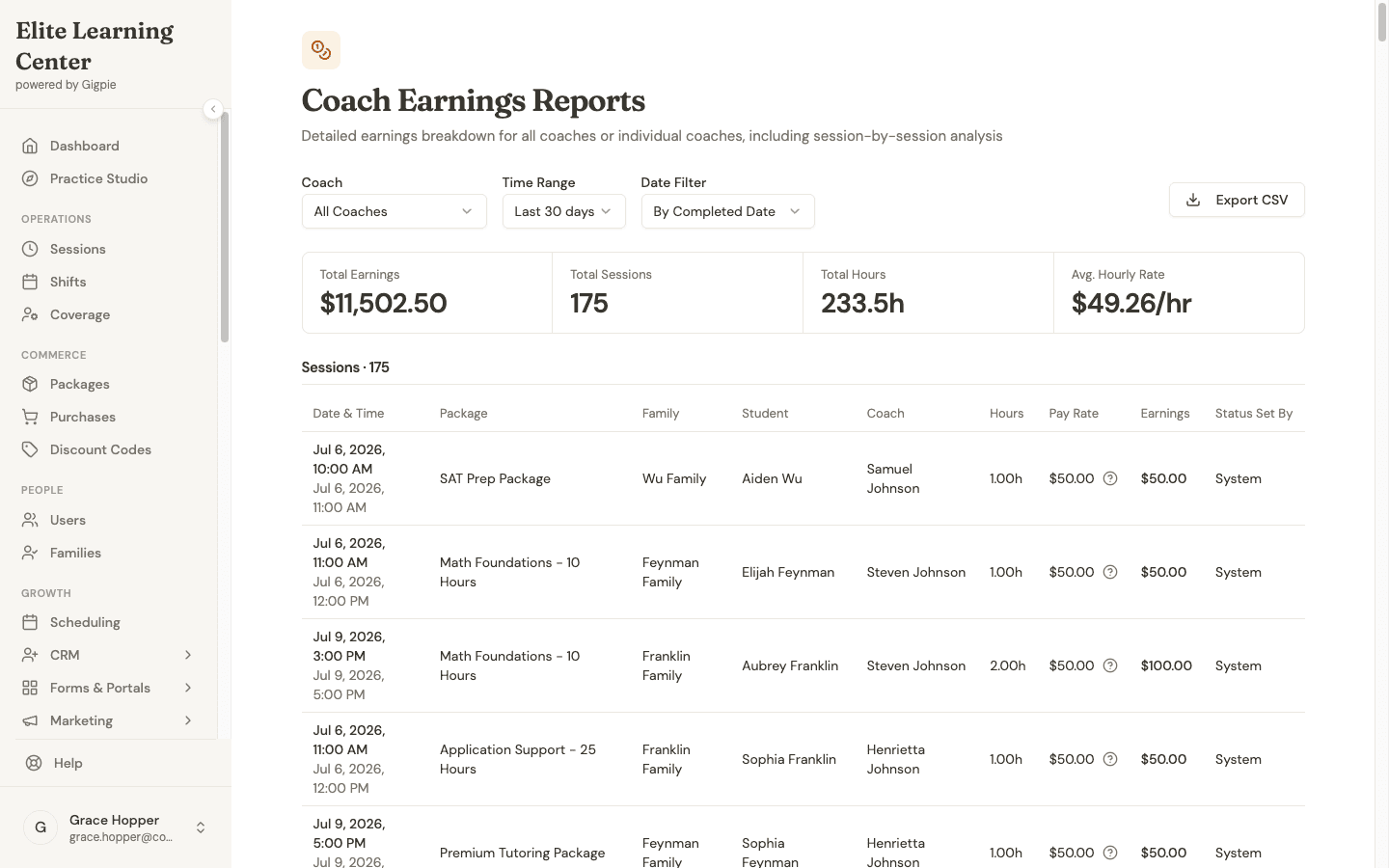 $11,502.50 across 175 sessions, split out by coach and rate. Gigpie totals what's owed; getting that money into a tutor's bank account automatically is still TutorCruncher's stronger claim.
Where the fit ends: at $3,000 a month in collections, Gigpie's 2% and TutorCruncher's Pay As You Go tier cost about the same, roughly $60 either way. Below that line, Gigpie is cheaper. Above it, TutorCruncher pulls ahead, and the gap grows with revenue: at $12,000 a month, Gigpie runs $240 against TutorCruncher's roughly $150 to $158, and at $40,000 it's $800 against about $340. If your agency already needs TutorCruncher's automated payouts and branch management, that gap is what Gigpie's CRM and family billing cost you, and it's worth running your own numbers before deciding the trade is worth it.
2. TutorBird
TutorBird trades TutorCruncher's revenue-percentage stacking for one flat number: $16.95 a month for the first tutor, $4.95 for each additional one, unlimited students, as of August 2026. Two-way Google and iCalendar sync ships at that price, along with Auto-Pay through Stripe or PayPal and phone support across three regions. Unlike TutorCruncher's non-refundable terms, TutorBird backs new accounts with a real 90-day money-back guarantee. What it drops is the agency layer: no split payments, no branch management, no revenue-share payroll option. It fits a small team that wants predictable per-seat pricing and doesn't place tutors with outside clients.
3. Teachworks
Teachworks meters by lesson instead of by tutor or revenue percentage: Starter is $16.49 a month plus $0.32 per student lesson, Growth is $47.99 plus $0.189, and Premium is $187.99 plus $0.065, with unlimited teachers on every tier, as of August 2026. It shares TutorCruncher's habit of selling core conveniences separately, two-way Google Calendar sync and client self-serve booking are both paid add-ons, but it backs that up with live chat and a 24/7 AI support agent that TutorCruncher doesn't offer. Growth and Premium tiers add API access and a QuickBooks Online integration. It fits an established center with steady lesson volume more than a placement agency chasing payout automation.
4. Tutorbase
Tutorbase undercuts TutorCruncher's stacked fees with a single percentage: no subscription, 1% when you create an invoice, as of August 2026. Calendar sync is two-way but Google only, no Outlook. Payroll works on the same principle as TutorCruncher's, calculated from finalized lessons with a manual approval step before pay goes out, though Tutorbase doesn't disburse straight to a tutor's bank account the way TutorCruncher's Stripe payouts account does. Its lead pipeline runs on WhatsApp instead of phone and email, and its team handles the data migration for you during a three-week onboarding. It fits a price-sensitive center that doesn't need multi-branch or split-payment tooling.
5. Wise
Wise is the other platform on this list that pays tutors directly rather than only calculating what they're owed: its payroll figures hourly or session-based pay, deducts taxes, and sends the money to a tutor's bank account, with split payments dividing an invoice between institute and tutor at the payment-gateway level. Pricing runs $0.69 per session or per seat, as of August 2026, unlimited tutors and admins included, with no separate transaction fee. It goes further than TutorCruncher on mobile: branded, white-labeled iOS and Android apps are a shipped, current feature, alongside session recording and AI summaries. It fits a live-class or group-tutoring operation better than a 1:1 placement agency, and its calendar sync, like Tutorbase's, is Google only.
What Moves Out of TutorCruncher, and What Doesn't
TutorCruncher is unusually well-documented on this one point. Dedicated CSV exports exist for students, tutors, jobs, lessons, and invoices, plus a separate accounting export for Xero, Sage, or QuickBooks. Pull all five before you cancel: a help article for closing a TutorCruncher account exists, and closing tends to cut off self-serve access to the export tools. None of that documentation is framed as "export to leave us," it's built for backups and bookkeeping, but the files are the same ones a migration needs.
What doesn't travel cleanly: split-payment history, which invoice paid which tutor how much, generally lives inside TutorCruncher's own payout records rather than a portable field, so reconstruct that ledger from your accounting export rather than expecting it in the students/tutors/lessons files. Saved card details on file through TutorCruncher's Stripe integration also don't carry to a new vendor's Stripe account; families re-enter cards wherever you land. On Gigpie's side, there's no automated importer for any outside platform, so those five files become the source you re-key from by hand rather than something you upload directly.
Frequently Asked Questions
Why do people search for TutorCruncher alternatives?
Mostly because the bill is hard to predict from the pricing page alone. A real TutorCruncher invoice can combine the tier fee, a revenue percentage, card processing, and add-ons for branches, a custom domain, or extended support, so people go looking for one number instead of five. Others simply don't need the split-payment payout tooling the price is built around.
Can I export my data from TutorCruncher?
Yes, and it's documented clearly: dedicated CSV exports exist for students, tutors, jobs, lessons, and invoices, plus an accounting export for Xero, Sage, or QuickBooks. Pull them before you close your account, since a published help article for closing a TutorCruncher account exists and account closure typically ends self-serve export access.
Is TutorCruncher's 30-day money-back guarantee real?
No, as of August 2026, not according to TutorCruncher's own terms. Its Terms and Conditions state billing is non-refundable, with no credit for partial months or unused service. The 30-day guarantee some review sites mention appears nowhere on tutorcruncher.com and contradicts that language directly.
Am I locked into a TutorCruncher contract?
TutorCruncher's terms describe monthly billing in arrears with no refunds, which functions like a month-to-month agreement rather than a fixed term, but there's no explicit cancel-anytime language either. New signups get a two-week free trial before the first charge.
Which TutorCruncher alternative is cheapest?
Tutorbase, on the fee line alone: 1% of invoiced amounts with no subscription, versus TutorCruncher's $30-to-$240 tiers plus a revenue percentage. TutorBird's flat $16.95 plus $4.95 per tutor is often the smallest absolute bill for a very small team. Gigpie's 2% only beats TutorCruncher's platform fee below roughly $3,000 a month in collections, and costs nothing before collections exist. Above that line the 2% is bidding on a different job: replacing the CRM, campaign tool, and add-on catalog you'd otherwise assemble around a cheaper fee, one number instead of five.
Does any alternative pay tutors directly, like TutorCruncher does?
Wise does. Its payroll calculates hourly or session-based pay, deducts taxes, and sends payment straight to a tutor's bank account, with split payments dividing an invoice between institute and tutor at the gateway level. Tutorbase and TutorBird calculate what's owed but stop short of disbursing it. Gigpie's payroll runs end in a CSV export, including a Justworks timecard, for your own payroll processor, not a direct bank transfer.
Do any of these have a native mobile app?
Wise does, with branded, white-labeled iOS and Android apps. TutorCruncher, TutorBird, Teachworks, Tutorbase, and Gigpie are all responsive web apps with no app-store listing, as of August 2026. Check each one's mobile web experience in a trial rather than assuming a page that mentions 'mobile' means a downloadable app.
Does Gigpie import TutorCruncher data automatically?
No. Gigpie has no automated importer for TutorCruncher or any other outside platform. Moving from TutorCruncher means pulling the CSV exports for students, tutors, jobs, lessons, and invoices first, then re-entering that data by hand, including reconstructing split-payment history from the accounting export since it isn't in the standard files.
When should I switch, mid-cycle or between terms?
Between terms. Open jobs, part-paid invoices, and pending tutor payouts all need to clear or get recreated on the new platform without paying or charging anyone twice. A break between terms gives you a clean cutover date instead of untangling active split payments mid-stream.
Will parents or clients need to re-enter payment details?
Yes. TutorCruncher's saved cards live inside its own Stripe integration and don't carry over to a different vendor's Stripe account, no matter which platform you move to. Give families a heads-up before the first invoice on the new system, with a direct link to add a card, so nobody's payment fails on day one.
What does Gigpie include that TutorCruncher doesn't?
A CRM that pipes leads onto a Kanban board, an inbox threading email, SMS, and call activity into one place, broadcast and multi-step journey campaigns, an AI phone agent for calls nobody's free to answer, and automatic review requests after every session that steer 4- and 5-star responses toward Google, Trustpilot, and Thumbtack. TutorCruncher counters with automated tutor payouts, multi-branch support, and an Enterprise-tier API, none of which Gigpie offers as of August 2026.
Is any of these better for a UK-based agency specifically?
TutorCruncher publishes UK-specific pricing in pounds (£25 to £200) and lists GoCardless for Direct Debit collection, which is common for UK tutoring businesses. None of the alternatives here publish separate UK pricing; Gigpie, TutorBird, Teachworks, and Tutorbase all quote in dollars, so convert and compare against your actual currency exposure before switching.
Test the flat 2% against TutorCruncher's stacked fees
Set up your roster and run real invoices at no cost, since nothing is owed until you collect revenue, then compare the final number to TutorCruncher's tier, revenue fee, and add-ons.
Get started freeRelated Resources
- Gigpie vs TutorCruncher - The full head-to-head, with the crossover point worked out at three revenue levels.
- Educator Payroll - What Gigpie's payroll runs actually do, and why they end in a CSV export instead of a bank transfer.
- Best Tutoring Software 2026 - How TutorCruncher and the rest of the field compare on verified pricing.