
Homeschool Enrichment & Co-op Software
Run a homeschool co-op or enrichment program on Gigpie: public enrollment links families use to sign up themselves, multi-instructor scheduling, and one shared balance per household across every class. Flat 2% of collections.
You're not running a business. You're the parent who said yes at the spring planning meeting, and now you're tracking which of forty kids are enrolled in which of six Tuesday classes, who's paid for the term and who still owes, and which instructor, also a parent, also volunteering, needs a reminder about Thursday's room change. A shared spreadsheet handled this when the co-op had twelve families. It doesn't anymore.
Gigpie's account model fits better than it looks like it should for something built for tutoring centers: the family, not the student, holds the enrollment and the balance. One household's four kids across five classes and four instructors is one account, not four.
One Family, Every Class, One Balance
A household enrolling four kids in five classes doesn't create four records to reconcile. The family holds every purchase, and every class, instructor, and payment attaches to that one account. Price each class as its own package, fixed-hour or subscription, at whatever your co-op charges, and a family with kids in math, writing, and science sees all three balances on one login instead of chasing three separate signup forms.
New families don't need you to enter them. Share the enrollment link and a parent can sign up and pay without creating an account, using only an email address and a six-digit code. An intake form, allergy information, pickup authorization, whatever your co-op requires, can send itself automatically the moment payment clears, so the paperwork arrives before you have to chase it.
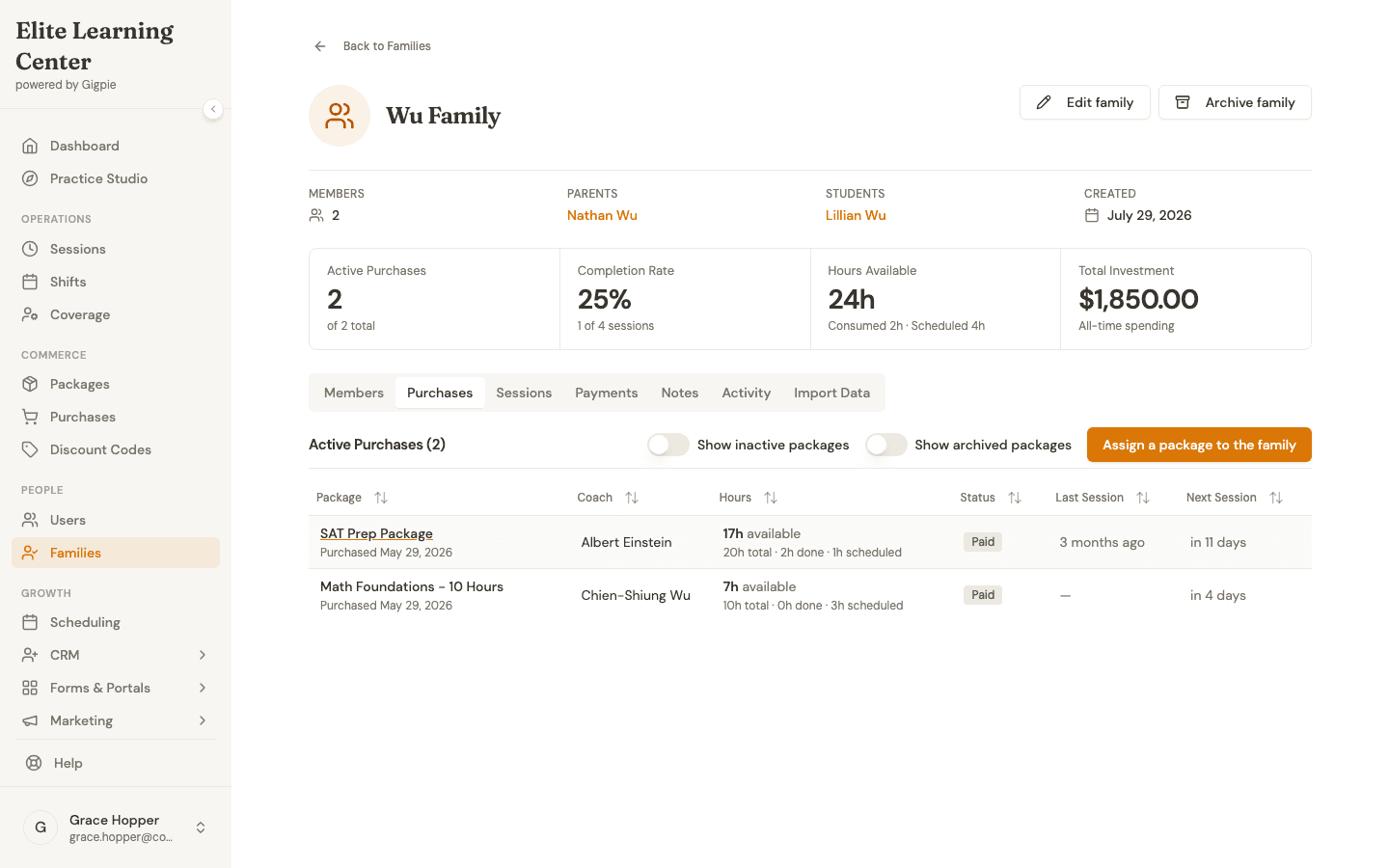 2 active purchases and 24 hours available on one family's login, the same one-balance view whether it's one class or five.
Tuesday's Four Classes, Four Instructors, One Schedule
Co-op classes mostly repeat on a fixed weekly slot, so a Tuesday math class is a recurring series rather than something rebooked by hand every week: same day, same time, for a set number of weeks or until a date you pick. Each class has a capacity cap and an enrollment mode, open registration, invitation-only, or reserved for families who've already bought the term package, with a drop-in price if you allow one-off visitors.
Instructors, whether they're paid staff or the parent running Thursday's art class, set their own weekly availability once, with a live preview of what families will see as bookable. There's no waitlist queue built in: when a class fills, enrollment closes, and reopening a spot after a family drops needs a manual message rather than an automatic offer to the next name in line.
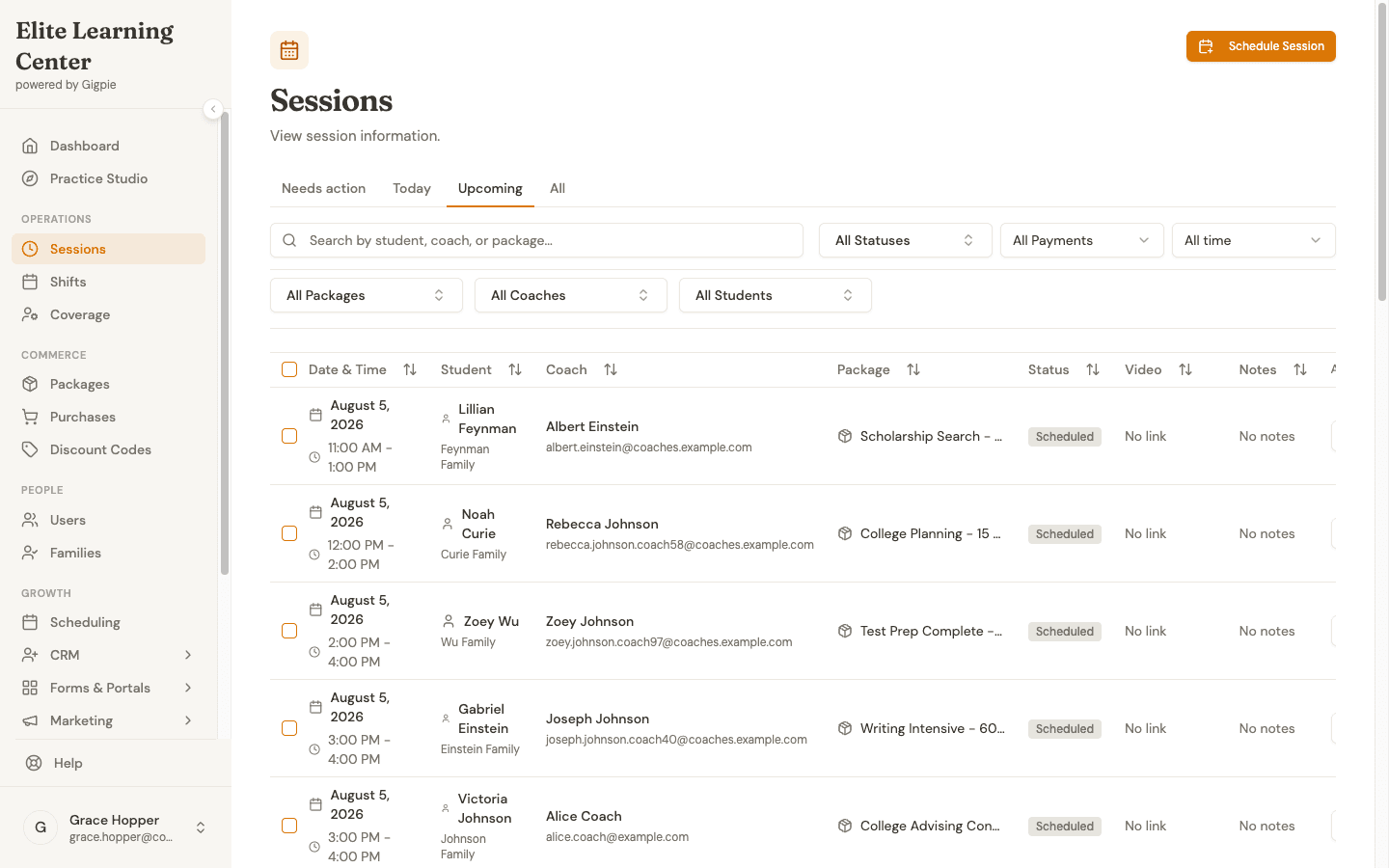 Tuesday's four classes and every other booking this week, one filterable list instead of four separate signup sheets.
Who Showed Up, and Who's Actually Paid
An instructor marks a session complete and writes a note in the same step, which parents read in full through the portal rather than a trimmed summary. If a student misses, the rule is fixed rather than negotiated: a no-show still counts against the family's package and the instructor is still paid for showing up; if the instructor is the one who's out, both reverse.
Instructor pay is built from the classes that actually happened. Pay groups and schedules handle instructors on different rates and cadences, each run locks in the rate at the moment it's built, and an approved run exports CSVs, a summary, session detail, and a Justworks-formatted timecard, for however you actually move the money.
The fee is flat: 2% of what you collect. A term where families pay $3,000 total costs $60. A summer where the co-op doesn't run and collects nothing costs nothing, and the sixth instructor costs the same to add as the first.
Where Gigpie Stops
Gigpie tracks who paid and who showed up, but it isn't a compliance tool. If your state requires a portfolio or attendance log for homeschool reporting, the session history is a reasonable paper trail, but nothing in the product formats or files it for you. There's also no automatic sibling discount: a discount code exists and a family can redeem it at checkout, but there's no rule that detects "third child enrolled" and applies a percentage on its own. If automated per-family pricing is central to how your co-op charges, plan to apply the code by hand or build it into the package price.
Getting Started
- Create your account and connect Stripe. Onboarding runs through Stripe Connect, and Gigpie is free until you collect revenue.
- Build your packages. One per term, class bundle, or subject, at whatever prices or stipend structure your co-op uses.
- Invite your instructors. They set weekly availability once, with a live preview of what families can book.
- Share the enrollment link. Families sign up and pay themselves, no data entry from you required.
These guides show the day-to-day workflows, recorded from the product:
- Managing Recurring Sessions - How families set up a weekly class series
- Purchase a Package - Enrolling and paying online, no account needed
- Enroll in a Group Class - Joining a class from the portal
- Mark Session Complete & Add Notes - How instructors close out a class and write the note
Frequently Asked Questions
Does this work for a volunteer-run co-op, not a registered business?
Yes. The account still runs through Stripe Connect the way any Gigpie account does, but nothing about the scheduling or billing tools requires a dedicated administrator. Many co-ops run on a rotating parent volunteer.
Can families enroll and pay themselves, without me entering each one?
Yes. Share your enrollment link and a parent can sign up and pay with just an email address and a six-digit code, no account creation on either side.
Can one family's kids be spread across many different classes and instructors?
Yes. One family account covers every child and every class, with a balance you can track per class or combine into one term package, whichever matches how you bill.
Do sibling discounts apply automatically?
Not automatically. Discount codes exist and can be applied at checkout, but there's no rule that detects a second or third enrolled sibling and discounts the price on its own.
What happens when a class fills up?
Enrollment closes at the capacity you set. There's no waitlist feature, so if a spot opens later, you'll need to reach out to the next family yourself.
Does payroll work if instructors are on different pay schedules?
Yes. Pay groups and schedules handle instructors on different rates and cadences within the same co-op, each run locks in the rate at the moment it's built, and an approved run exports a CSV for however you actually pay people.
Run your co-op on one system
Free until you collect revenue, then a flat 2% of what families pay you. No seat fees, no minimum roster size.
Get startedRelated Resources
- Enrichment Program Solutions - The broader after-school and camp version of this same multi-instructor model
- Family Management - How one household's enrollment and balance work across every class
- Test Prep Solutions - Where co-ops often add Gigpie next, as older students start SAT or ACT prep