
Language School Management Software
Run a language school on Gigpie: group classes and private lessons on one calendar, per-language package balances, timezone-aware scheduling for remote instructors, and payroll exports. Flat 2% of collections.
Tuesday's roster has a five-year-old starting Mandarin, two teenagers moving from beginner to intermediate Spanish, and a household that wants their son's ESL sessions and their daughter's French class billed together, not as two separate accounts. Your Spanish instructor teaches from Barcelona and logs in at what is, for her, midmorning. None of that fits software built for one subject, one level, one time zone.
Gigpie solves the family half of the problem the way it does for every tutoring business on it: the family, not the student, holds the purchase, and the languages and instructors underneath it split apart or pool depending on how you bill.
One Family, Two Languages, Two Balances (or One)
Enrolling a son in Mandarin and a daughter in French happens on one screen: enter the parent and both students, pick each child's package, assign an instructor to each, and the payment summary updates as you go. Sell "Mandarin, 10 hours" and "French, 10 hours" as two packages under one family and each keeps its own balance. Sell one combined package instead, and both kids draw from the same pool, which is genuinely pooled: Gigpie doesn't cap either child's share, so a sibling who burns through hours faster is better sold a separate package.
Families who find you online can buy either way without your involvement, with just an email address and a six-digit code, and an intake form asking about prior exposure can send itself the moment payment clears.
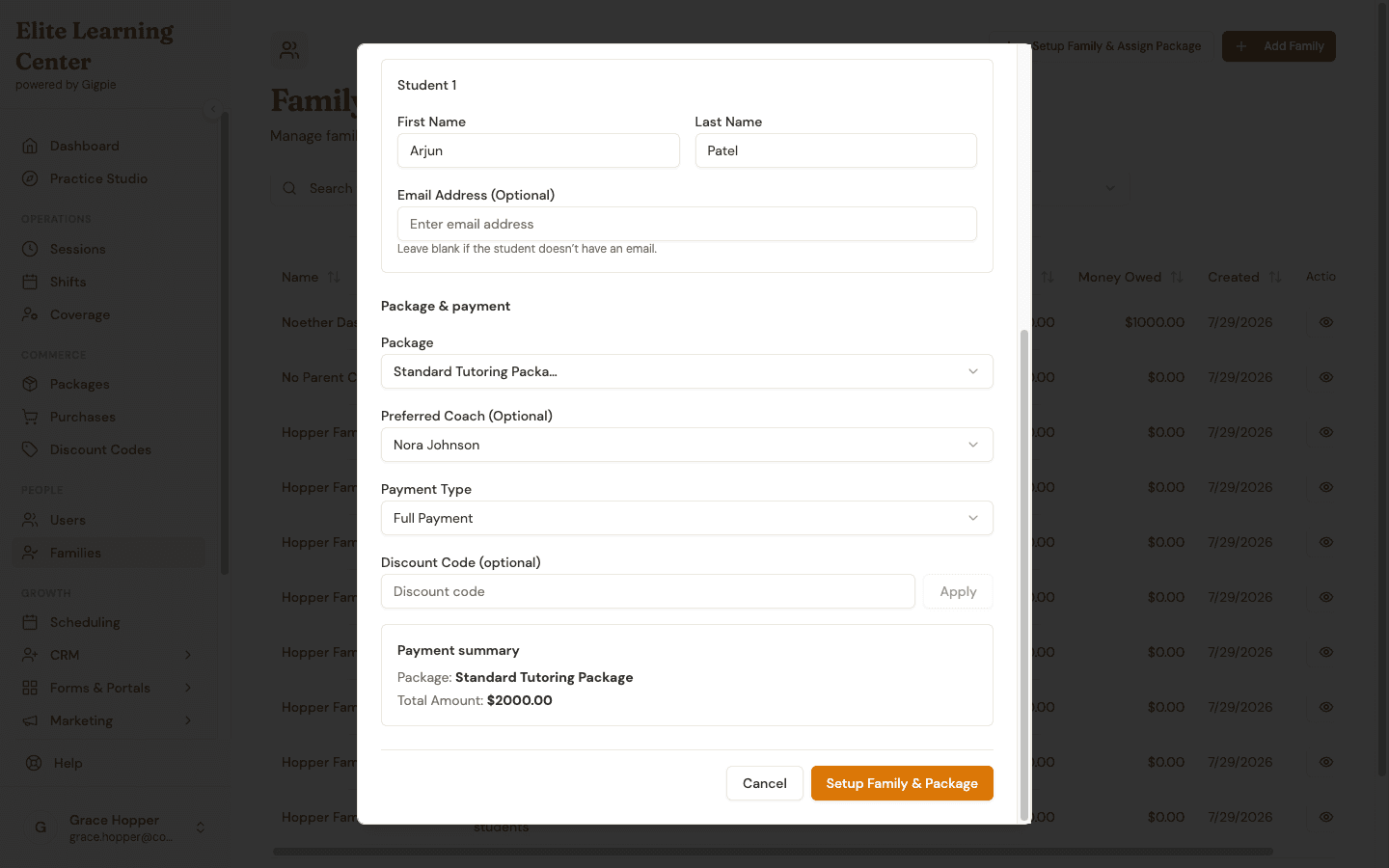 Parent info, a package, and an instructor, one flow, one screen; the same modal handles a single language or two side by side.
Group Classes on One Schedule with Private Lessons
Most schools run private lessons for grammar and pronunciation alongside group classes for conversation practice, and Gigpie books both on one schedule. A group class has a capacity cap and an enrollment mode, open, invitation-only, or reserved for package holders, with a drop-in price for a visiting student who hasn't bought a package.
Because lessons mostly repeat, a standing slot is a recurring series rather than something rebooked by hand each week: weekly, for a set number of weeks, until a date, or indefinitely, with families setting the cadence themselves from the portal. A missed lesson follows a rule instead of a negotiation: a student no-show still consumes the package hour and still pays the instructor, and if the instructor misses instead, both reverse.
An Instructor in Barcelona, a Family in Denver
Hiring across time zones is ordinary for a language school in a way it isn't for most tutoring businesses. Every Gigpie user's timezone is detected automatically from their browser, so a family in Denver books a 4pm lesson and the instructor in Barcelona sees it land on her calendar at the correct local hour, with nobody configuring anything.
Instructors set their own weekly availability once, with a live preview of what families will see as bookable. Sessions also push to a connected Google or Outlook calendar and check its busy times at booking, so a personal appointment an instructor only put on her own calendar still blocks the slot. That check happens at booking, not continuously, so an event added afterward is caught at the next attempt.
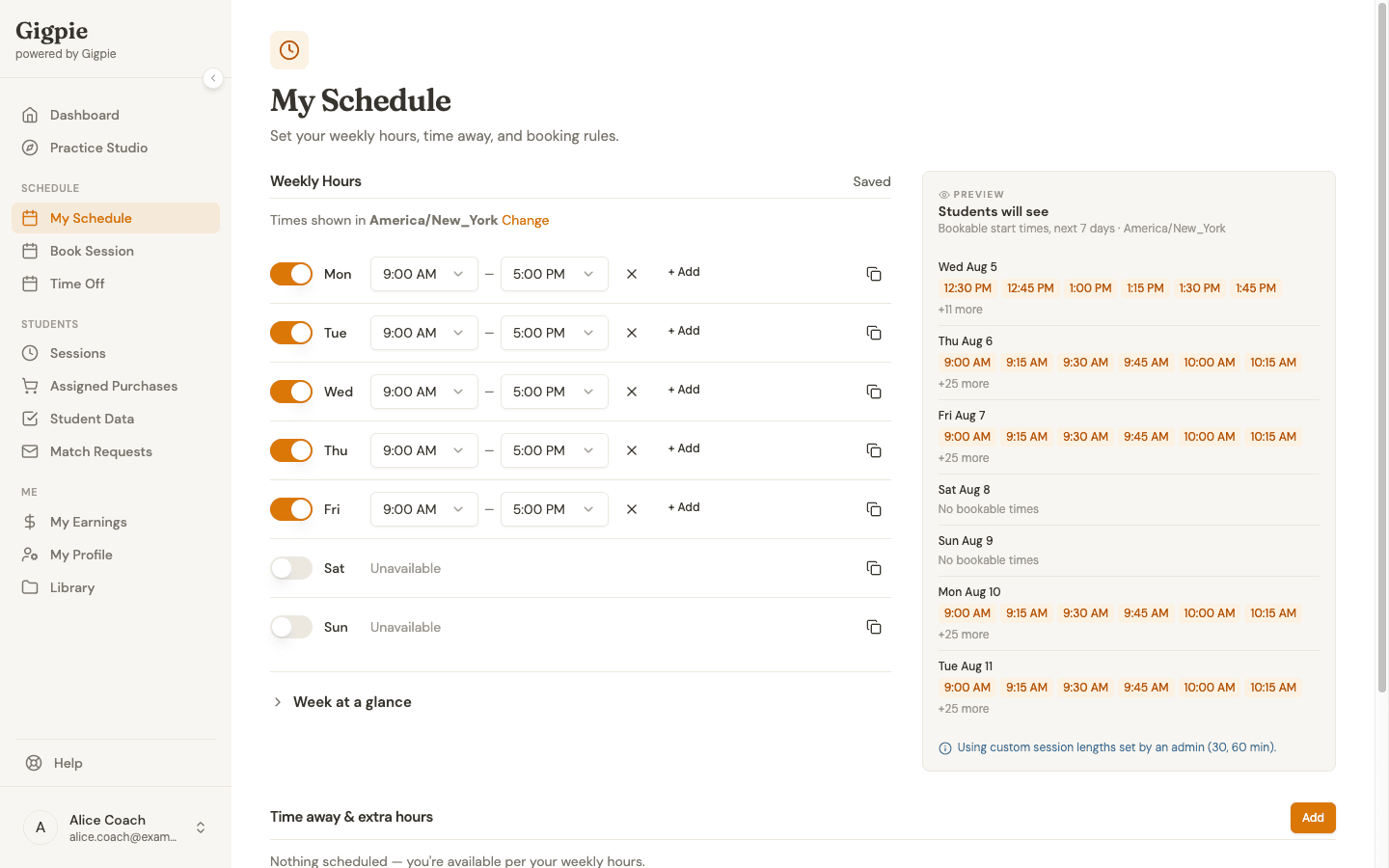 Monday to Friday, 9 to 5, and beside it the exact times families will see, whichever time zone the instructor sets it from.
From Session Note to Paycheck
An instructor finishes a lesson, marks it complete, and writes the note in the same step. Parents read the whole note, not a trimmed summary, and the same record carries the instructor's pay for the hour. Gigpie also asks the family for a rating, one to five stars plus a comment, and points five-star (widenable to four in settings) responses at your Google, Trustpilot, or Thumbtack review page.
Payroll runs from the lessons that actually happened. Pay groups and schedules handle instructors on different rates and cadences, each run locks in the pay rate when it's built, and a paid run can't be edited afterward. Approving a run produces CSVs, a summary, session detail, and a Justworks-formatted timecard, for your payroll processor. Gigpie calculates what an instructor is owed; it doesn't transfer it.
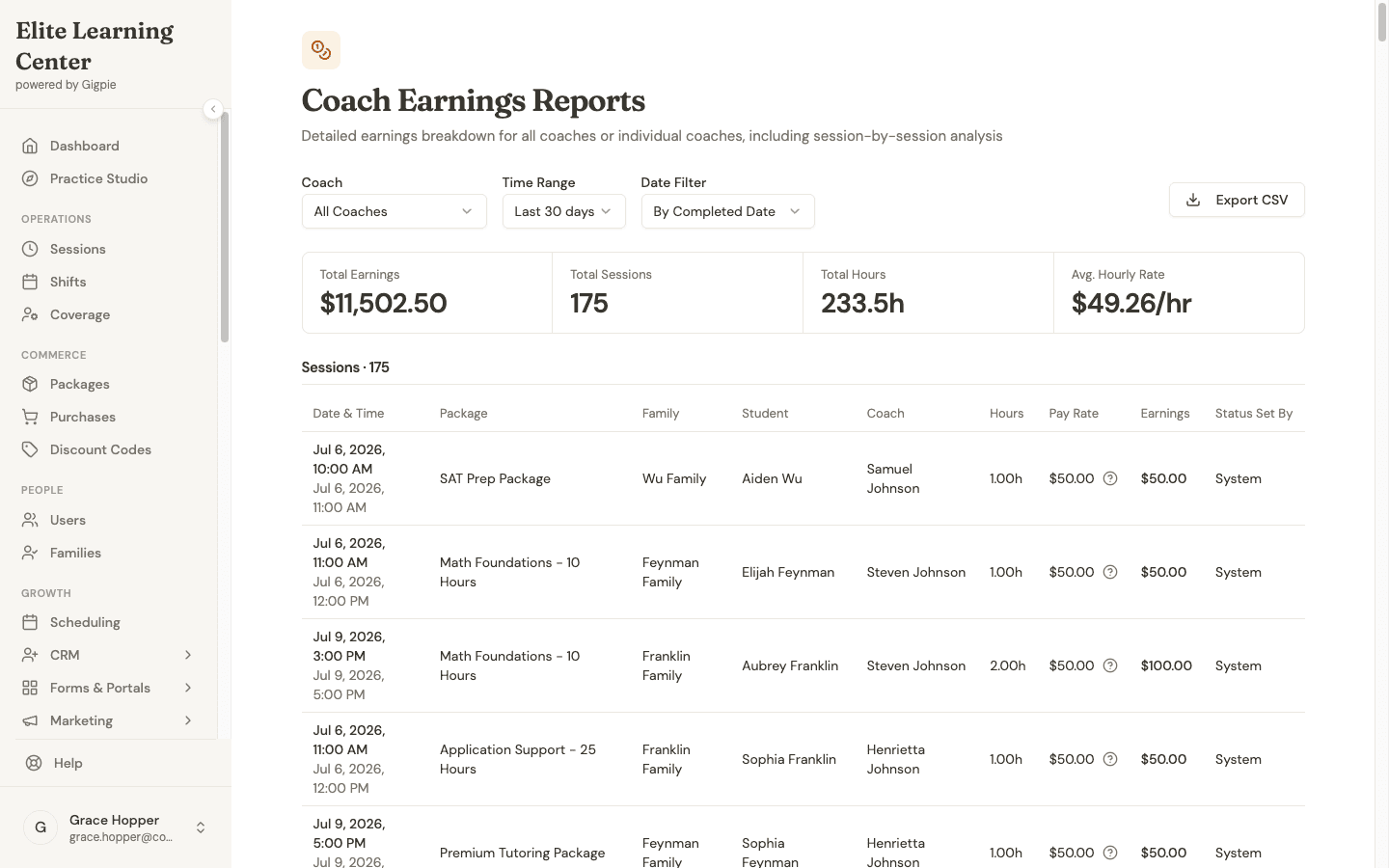 $11,502.50 earned across 175 sessions last month, broken out by instructor and rate, the same report a payroll run pulls from.
The platform fee is flat: 2% of what families pay you. Collect $9,000 across every language in a busy month and it costs $180. A quiet month with nothing collected costs nothing, and a ninth instructor is free to add, the same as the first eight.
Where Gigpie Stops
Gigpie doesn't teach the language, and it doesn't structure how you track proficiency either. There's no CEFR or ACTFL level system built in, no vocabulary decks, no placement-test engine. A session's progress note is one free-text field, so "moved him up to intermediate" lives in a sentence an instructor writes, not a status the product tracks on its own. Levels live in your package names instead: sell "Spanish A2, 10 hours" as its own package, and the level survives as a line item even though nothing enforces it underneath.
Getting Started
- Create your account and connect Stripe. Onboarding runs through Stripe Connect, and Gigpie is free until you collect revenue.
- Build your packages. One per language and level, fixed-hour or subscription, priced however you sell today.
- Invite your instructors. They set weekly availability once, with a live preview of what families can book.
- Add families. Enter them yourself, or send the purchase link and let parents buy without creating an account.
These guides show the day-to-day workflows, recorded from the product:
- Managing Recurring Sessions - Setting up and adjusting a weekly lesson series
- Purchase a Package - Buying lesson hours online, no account needed
- Enroll in a Group Class - Joining a conversation class from the portal
- Mark Session Complete & Add Notes - How instructors close out a lesson and write the note
Frequently Asked Questions
Can a family split billing across two languages, or combine it into one balance?
Either. Sell separate packages per language and each keeps its own balance, or sell one combined package and both children draw from a single pool. The pool is genuinely shared, so families where one sibling burns through hours faster are better served by separate packages.
Do you support group conversation classes alongside private lessons?
Yes, on one schedule. A group class has a capacity cap and an enrollment mode (open, invitation-only, or package holders only), with drop-in pricing for visiting students.
Can one instructor teach more than one language?
Yes. There's no separate language field to configure. You assign an instructor to whichever language package a family buys, the same mechanism used for any package.
Does Gigpie work across time zones for remote or native-speaker instructors?
Yes. Every user's timezone is detected automatically from their browser, so an instructor teaching from abroad and a family booking locally each see session times converted to their own zone.
What does Gigpie cost?
A flat 2% of what you collect from families. No monthly fee, no per-instructor seat fee, and it's free until you collect revenue.
Run your language school on one system
Free until you collect revenue, then a flat 2% of what families pay you. No seat fees, no per-language pricing.
Get startedRelated Resources
- Family Management - How shared and split package balances work under one household
- Smart Scheduling - Recurring series, group classes, and the availability editor
- Music School Solutions - The same family-billing model applied to multi-teacher music lessons